Complaint: What a Civil Complaint Is, How It's Filed, and What Happens After Service
A complaint is the written pleading that opens a civil lawsuit. The plaintiff files it with the clerk of court, the clerk issues a summons, and from that moment the dispute is no longer a private grievance but a docketed case with contempt-backed deadlines for every party. Federal practice runs on FRCP Rule 8, which requires a short and plain statement of jurisdiction, the claim, and the relief sought. State courts run their own analog rules. This pillar walks through what a civil complaint is, the plausibility doctrine that governs every modern federal pleading, the seven-block anatomy of the document itself, the procedural arc that begins the moment the complaint is filed, and the five drafting defects most likely to get a case dismissed before discovery starts.
- What a Complaint Is, and What It Is Not
- The Plausibility Standard: Twombly, Iqbal, and the End of Notice Pleading
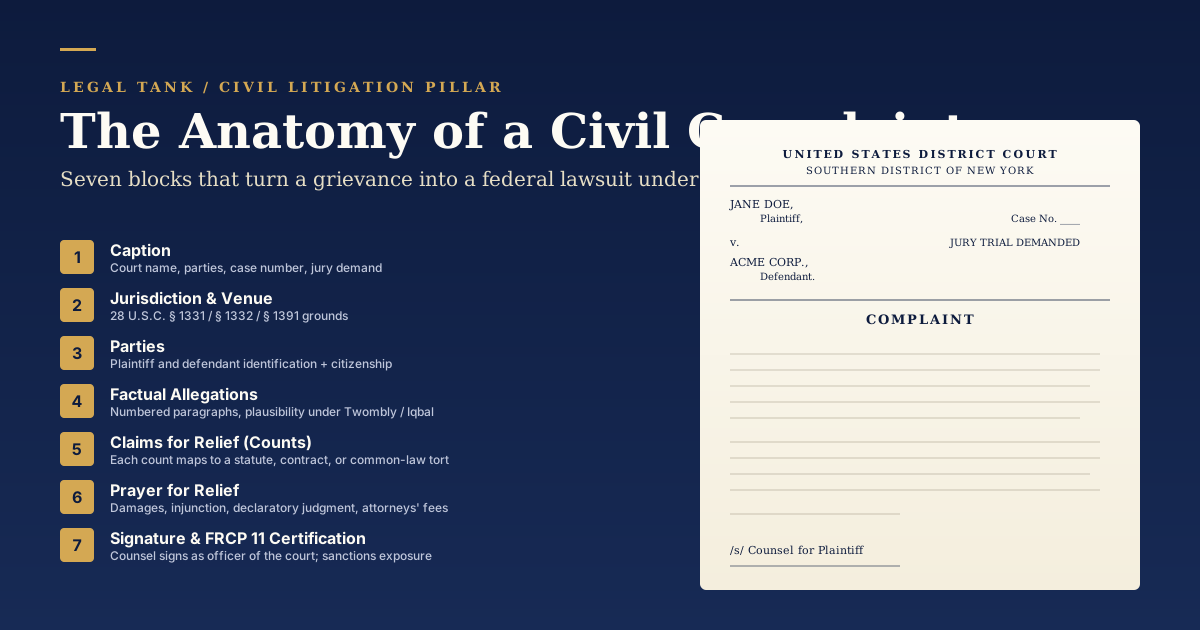
- The Seven-Block Anatomy of a Civil Complaint
- From Filing to Discovery: The Procedural Arc After You File
- Where Complaints Fail: Five Drafting Defects That Sink Cases
- Frequently Asked Questions
What a Complaint Is, and What It Is Not
The word complaint carries four distinct meanings in American law, and the consequences attached to each are different. In civil practice a complaint is the pleading that initiates a lawsuit by stating claims against a named defendant. In criminal practice a criminal complaint is the charging document signed by a prosecutor or law enforcement officer that begins a criminal proceeding under Rule 3 of the Federal Rules of Criminal Procedure. In administrative practice a complaint or charge is a filing with an agency, such as an EEOC charge under Title VII or an OSHA complaint, that triggers an agency investigation but does not (by itself) generate a court case. In consumer-protection practice a complaint is a written submission to a regulator such as the FTC, the Consumer Financial Protection Bureau, the state attorney general's consumer division, or the Better Business Bureau, which does not commence litigation at all. This pillar concerns the civil-pleading sense.
The civil complaint is the document that converts a private dispute into a lawsuit. Filing the complaint with the clerk of court does three things at once. It opens a case with a case number, a court calendar, and contempt-backed deadlines for every party. It stops the statute of limitations from running as of the filing date, which is why timing matters for any claim approaching its limitations period. And it triggers the issuance of a summons, which the plaintiff must then serve on each defendant under FRCP 4. A complaint that is drafted but not filed has no procedural effect; a complaint that is filed but not served can be dismissed for want of prosecution. The act of filing and the act of service are what convert a draft into a live lawsuit.
A civil complaint is also distinct from a pre-suit demand. A professionally drafted demand letter asks the recipient to pay, perform, or stop a course of conduct, with the threat of litigation if the demand is not met. The demand letter is the last off-ramp before the complaint. Many disputes resolve at the demand stage and never become lawsuits. When the demand fails, the complaint is the next instrument; for personal injury matters the personal-injury demand letter that precedes a complaint is often paired with the filed pleading to strengthen settlement posture in the first weeks of the case. Before either instrument is drafted, plaintiffs weighing whether the claim is worth filing often start by valuing the injury with a personal injury settlement calculator to gauge the compensatory range the prayer for relief will later seek.
Civil complaints come in several procedural shapes within the same family. The original complaint is the first pleading filed. An amended complaint is a revised version filed under FRCP 15, either as of right within twenty-one days of service or by consent or leave thereafter; the amended complaint meaning is procedurally the same document, with additions, deletions, or corrected allegations, and it relates back to the original filing date under Rule 15(c) when the new claim arises out of the same conduct, transaction, or occurrence. A small claims complaint is the simplified form-based pleading used in state small-claims courts (dollar thresholds vary by jurisdiction, generally between five and twenty-five thousand) where the procedural rules are streamlined and most parties appear without counsel. A complaint for absolute divorce is the family-court analog used in states that retain the historical "absolute divorce" label; the structure tracks the civil-pleading skeleton but the substantive law is state family-code, not federal civil procedure.
The Plausibility Standard: Twombly, Iqbal, and the End of Notice Pleading
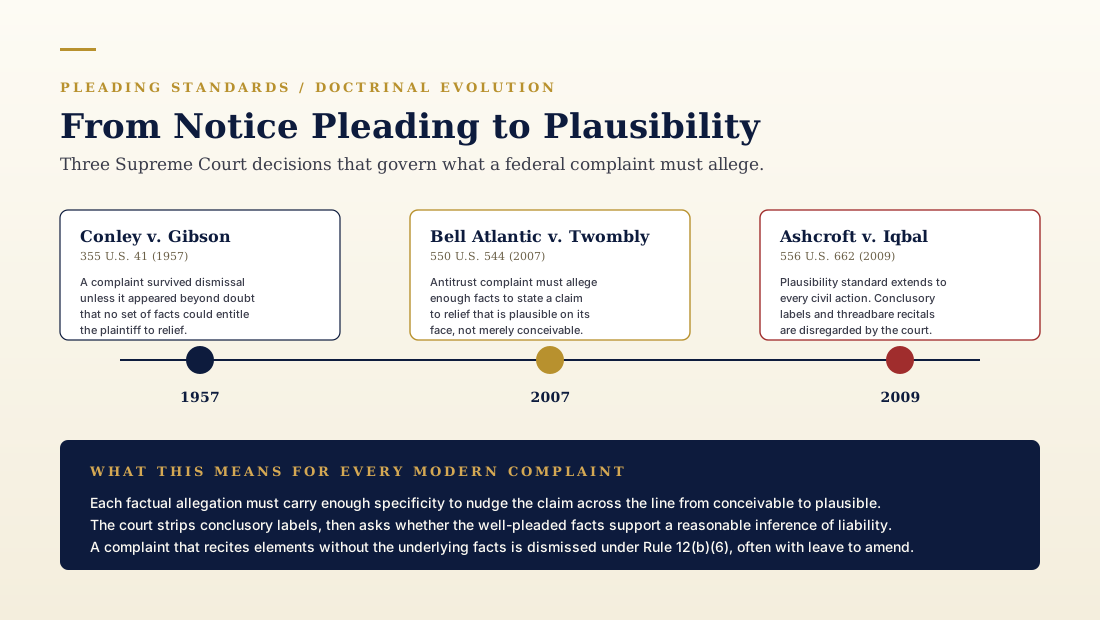
For half a century the federal pleading standard was the one announced in Conley v. Gibson, 355 U.S. 41 (1957): a complaint was sufficient unless it appeared beyond doubt that the plaintiff could prove no set of facts in support of the claim that would entitle him to relief. That standard was forgiving. A complaint that gave the defendant fair notice of the claim and the grounds for it was enough; the rest belonged to discovery. In practice, this meant that a plaintiff with a barely articulated claim could often survive a motion to dismiss and force the defendant into the expensive phase of the case. That is the standard that no longer exists.
Bell Atlantic v. Twombly (2007): The First Crack in Conley
In Bell Atlantic Corp. v. Twombly, 550 U.S. 544 (2007), the Supreme Court evaluated an antitrust complaint alleging that regional Bell operating companies had conspired to restrain competition. The Court rejected the complaint as insufficient, announcing that a complaint must contain enough factual matter, taken as true, to state a claim to relief that is plausible on its face. The Court explicitly retired the "no set of facts" language from Conley, calling it an "incomplete, negative gloss" that had "earned its retirement." Twombly was decided in the antitrust context, and for two years lower courts argued about whether its plausibility standard applied only to antitrust pleadings or to every civil claim. That argument was settled in 2009.
Ashcroft v. Iqbal (2009): Plausibility Becomes Universal
In Ashcroft v. Iqbal, 556 U.S. 662 (2009), the Court extended the plausibility standard to every civil action filed in federal court. Iqbal had sued senior Bush administration officials for alleged constitutional violations in the post-September-11 detention program. The complaint alleged that the officials had adopted a discriminatory policy. The Court held that the allegation of a discriminatory policy was a conclusory label that the court disregards before running the plausibility analysis; the non-conclusory facts that remained did not plausibly support the inference of liability. The opinion set out a two-step framework: first, strip the conclusory allegations; second, ask whether the well-pleaded facts that remain support a reasonable inference that the defendant is liable.
What This Means When Drafting a Modern Complaint
Every numbered paragraph in the factual section of a modern civil complaint has to do two things at once. It has to plead the underlying facts (who did what, when, and where) with enough specificity that the court accepts them as well-pleaded. And the facts in the aggregate have to support a reasonable inference of liability on each element of each claim. Threadbare recitals of the elements of a cause of action, supported by mere conclusory statements, do not suffice. The discipline that wins on a Rule 12(b)(6) motion is to draft the facts first, before drafting the counts, and to map each fact to an element it supports. A complaint built from element checklists backward into facts almost always reads as conclusory; a complaint built from facts forward into elements almost always reads as plausible.
See FRCP 12 in its current form for the full menu of grounds a defendant can raise to dismiss the complaint before answering, including the failure-to-state-a-claim ground under Rule 12(b)(6) on which the Twombly and Iqbal analysis operates.
The Seven-Block Anatomy of a Civil Complaint
Every federal civil legal complaint carries the same seven structural blocks, in the same order, regardless of whether the claim is a breach-of-contract dispute, a personal-injury negligence action, a trademark-infringement matter, or a Title VII employment claim. State-court pleading varies in vocabulary and in local rule formalities, but the skeleton is the same. Reading a served complaint is a matter of working through these seven blocks in sequence; drafting one is a matter of building each block against the legal claims it has to support.
Block 1
Caption
Court name, full case caption (parties named in the same order they appear on the docket), case number left blank for the clerk to assign, document title (COMPLAINT in capitals), and a jury-trial demand under FRCP 38(b) if jury rights are being preserved. A defective caption can trigger a Rule 12(b)(4) insufficient-process challenge.
Block 2
Jurisdictional Statement
A short paragraph stating the basis of federal subject-matter jurisdiction (federal question under 28 U.S.C. section 1331, diversity of citizenship under section 1332, or supplemental jurisdiction under section 1367) and venue under section 1391. The jurisdictional statement is the first thing the court reads on a Rule 12(b)(1) motion to dismiss, so the facts that support each prong must appear here, not inferred from the body.
Block 3
Parties
Each party identified by full legal name, principal place of business or state of citizenship, and (for diversity cases) the facts that establish complete diversity under Strawbridge v. Curtiss. Corporate defendants identified by state of incorporation and principal place of business per Hertz Corp. v. Friend. Limited liability companies require the citizenship of every member to be alleged, which is the most-missed pleading point in modern diversity practice.
Block 4
Factual Allegations
Numbered paragraphs setting out the events that gave rise to the dispute, in chronological order, with enough specificity that the court can run the plausibility analysis under Twombly and Iqbal. Each paragraph contains one fact, not a string of facts. Conclusory labels ("the defendant acted negligently") are disregarded by the court; the underlying facts that support the conclusion must appear ("the defendant ran the red light at the intersection of X and Y at 2:14 p.m. on October 3, 2025").
Block 5
Claims for Relief (Counts)
Each cause of action set out as a separately numbered count. Every count names the legal theory (breach of contract, negligence, trademark infringement, defamation, Title VII discrimination), identifies the statute or common-law source, and re-alleges the supporting facts by reference to the paragraphs above. Counts can plead in the alternative under FRCP 8(d)(2) and can be inconsistent so long as each is well-pleaded standing alone.
Block 6
Prayer for Relief
The remedies the court is asked to grant: compensatory damages, punitive damages where authorized, equitable relief such as an injunction or specific performance, declaratory judgment, prejudgment interest, attorneys' fees where the contract or statute permits, and costs of suit. The prayer controls what the court can later award, so a remedy not requested may be unavailable even after a successful trial.
Block 7
Signature and FRCP 11 Certification
Counsel's signature block, including the law firm name, bar admission, address, telephone, and email. The signature operates as a Rule 11 certification: counsel has read the complaint, the factual allegations have evidentiary support or are likely to after a reasonable opportunity for discovery, the legal contentions are warranted by existing law or a non-frivolous extension of it, and the filing is not being made for an improper purpose. Sanctions under FRCP 11(c) attach to violations.
How a Legal Complaint Example Reads in Practice
A representative legal complaint example in a commercial breach matter would carry the caption naming the plaintiff supplier and the defendant buyer in the Southern District of New York, a jurisdictional statement invoking diversity under 28 U.S.C. section 1332 and citing the parties' citizenship, a parties block identifying the plaintiff as a Delaware LLC with members citizens of New Jersey and the defendant as a New York corporation, a factual block running roughly forty numbered paragraphs describing the master services agreement, the purchase orders, the dates of non-payment, and the demand correspondence, a single count for breach of contract under New York law (or two counts in the alternative: breach of contract plus account stated), a prayer for relief seeking compensatory damages, prejudgment interest, attorneys' fees under the contract's fee-shifting clause, and costs, and a signature block with counsel's bar admission and the FRCP 11 certification. Total length: typically twenty to thirty pages, with exhibits attached if the contract or the demand correspondence is being incorporated by reference.
For the substantive cause of action that drives the count in most commercial complaints, our pillar on the breach-of-contract demand letter that precedes the count walks through the element-by-element drafting discipline that turns a payment dispute into a count that survives a Rule 12(b)(6) motion.
From Filing to Discovery: The Procedural Arc After You File
Once the complaint is signed and ready, the procedural arc from filing through to the start of discovery runs on a tight set of deadlines. The seven stages below describe the federal civil track; state-court practice is functionally similar but varies in calendar specifics. Knowing the arc matters even for the plaintiff who is being represented, because each stage exposes a different risk and creates a different obligation that has to be met on time.
File With the Clerk and Pay the Filing Fee
The complaint is filed electronically through the court's CM/ECF system in federal practice (or the state equivalent), accompanied by the civil cover sheet, the corporate disclosure statement under FRCP 7.1 where applicable, and the filing fee or an application to proceed in forma pauperis. The clerk dockets the case, assigns a case number, and (in most districts) makes an initial judge assignment. Filing is the act that stops the statute of limitations from running.
Summons Issues
The clerk issues a summons under FRCP 4(b) for each defendant, signed and sealed. The summons identifies the court, names the parties, sets the twenty-one-day response deadline (or sixty days for defendants who waive personal service under FRCP 4(d)), and warns the defendant that failure to respond will result in default judgment.
Serve the Summons and Complaint Under FRCP 4
Personal service on the defendant or an agent authorized to accept service is the federal default under FRCP 4(e). Service must be completed within ninety days of filing under FRCP 4(m), or the court will dismiss without prejudice unless the plaintiff shows good cause for an extension. Waiver of service under Rule 4(d) is encouraged and gives the defendant a longer response window (sixty days from the request date rather than twenty-one from service).
The Defendant Answers or Moves Under Rule 12
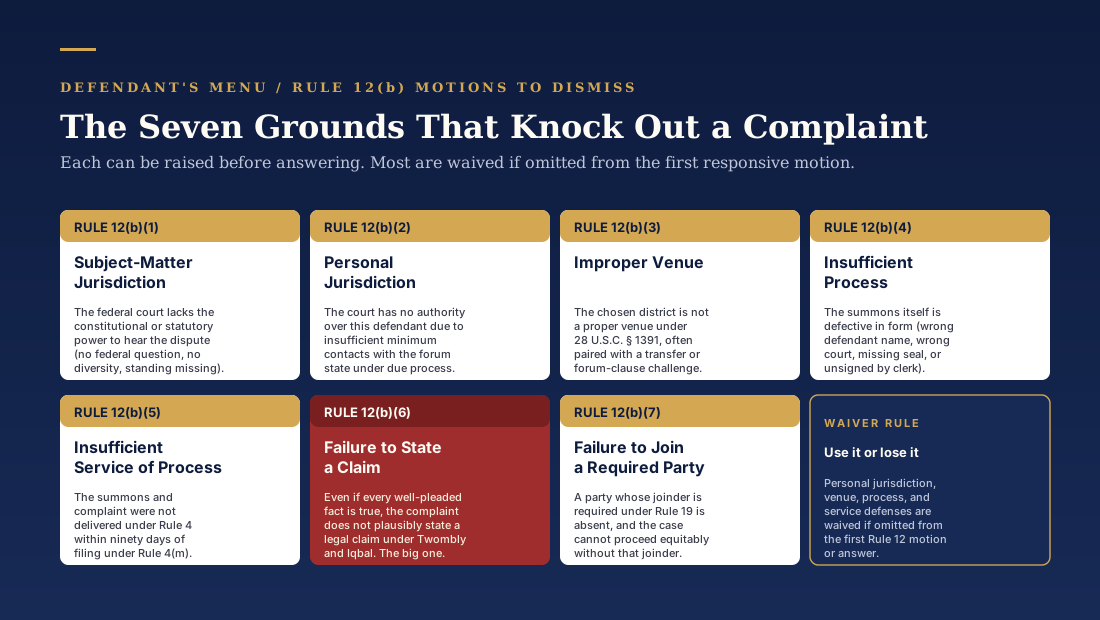
Within twenty-one days of service the defendant must file either an answer or a pre-answer motion under FRCP 12(b). The Rule 12 menu has seven grounds (lack of subject-matter jurisdiction, lack of personal jurisdiction, improper venue, insufficient process, insufficient service of process, failure to state a claim, and failure to join a required party). Defenses of personal jurisdiction, venue, process, and service are waived if omitted from the first responsive motion or answer under Rule 12(h)(1).
Affirmative Defenses and Counterclaims
If the defendant answers, FRCP 8(b) requires admit-or-deny responses to each numbered paragraph and FRCP 8(c) requires affirmative defenses to be raised in the answer or be waived. Compulsory counterclaims under FRCP 13(a) must be raised in the same answer or lost forever; permissive counterclaims under FRCP 13(b) can be raised at counsel's discretion.
Rule 16 Scheduling Order and Rule 26(f) Conference
After the pleadings close the court issues a scheduling order under FRCP 16(b) setting the discovery cutoff, motion deadlines, and trial date. Before the scheduling order, FRCP 26(f) requires the parties to confer and submit a joint discovery plan. This is when the litigation moves from pleading to discovery, the longest and most expensive phase of most civil cases.
Amendment Under FRCP 15
A complaint can be amended once as of right within twenty-one days of service or within twenty-one days of a Rule 12 motion under FRCP 15(a)(1). After that, amendment requires either the opposing party's written consent or leave of court, which Rule 15(a)(2) directs the court to grant freely when justice so requires. Amended complaints relate back to the date of the original filing under Rule 15(c) if the new claim arose out of the same conduct, transaction, or occurrence.
Once Discovery Starts, the Stakes Change
The end of the pleading phase is also the beginning of discovery, which is the longest and most expensive part of most civil cases. Discovery is built around document requests, interrogatories, depositions, and subpoenas to third parties. When one side refuses to produce, the procedural device that compels production is the motion to compel discovery, which is governed by FRCP 37 and runs on its own meet-and-confer requirement. The complaint sets the scope of the case, and the scope of discovery is in turn measured against the claims and defenses pleaded in the complaint and the answer, so what is or is not in the pleading determines what is or is not discoverable twelve months later.
For wrongful-death and survival-action complaints in particular, where the procedural deadlines run on top of state pre-suit notice requirements, our wrongful death demand letter pillar walks through the substantive elements a death claim has to document before suit and the pre-suit notice requirements that operate as jurisdictional prerequisites in many state systems.
Where Complaints Fail: Five Drafting Defects That Sink Cases
A well-drafted complaint advances to discovery and forces the defendant to engage with the substance of the claim. A defective one is dismissed at the pleading stage, often without leave to amend, after months of preparation and tens of thousands of dollars in legal time. The five defects below account for the vast majority of dismissed federal complaints, and each is preventable with the right drafting discipline before filing.
Failure to State a Claim Under FRCP 12(b)(6)
The most common dismissal ground in modern federal practice. Even if every well-pleaded fact in the complaint is accepted as true, the complaint does not plausibly state a legal claim. Under Twombly and Iqbal the court strips conclusory labels and asks whether the remaining factual content allows the court to draw a reasonable inference that the defendant is liable. Threadbare recitals of the elements of a cause of action will not survive. Cure: amend with specific factual allegations tied to each element of each claim.
Insufficient Particularity Under FRCP 9(b)
Claims of fraud, mistake, RICO, and certain securities-law violations must be pleaded with particularity: the who, what, when, where, and how of the alleged misrepresentation, plus scienter. General allegations that "the defendant made false statements about its product" will not survive. Cure: identify the specific statements, the speakers, the dates, the audience, and the documentary evidence by reference, before filing.
Shotgun Pleading
Every count incorporates by reference every preceding allegation, so each count contains every fact in the complaint and the court cannot tell which facts support which claim. The Eleventh Circuit has identified this as a recurring problem and has dismissed shotgun complaints sua sponte. Cure: re-allege only the specific paragraphs each count actually depends on, and keep each count separately readable.
Jurisdictional Gap
The complaint asserts diversity jurisdiction without alleging the citizenship of every party (especially every member of an LLC), or asserts federal-question jurisdiction without pointing to the federal statute that creates the cause of action. A Rule 12(b)(1) motion is never waived and can be raised at any time, including on appeal, so a jurisdictional defect can erase years of litigation. Cure: build the jurisdictional facts block before drafting any count.
Missed Statute of Limitations
A claim filed after the limitations period has run is barred. The defect appears on the face of the complaint when the events alleged predate the filing date by more than the limitations window. State limitations periods vary widely by claim type (two years for most negligence claims in many states, four years for written contracts under UCC section 2-725, ten years for fraud against the government in some jurisdictions). Cure: calendar the limitations date from the date of accrual and file with margin, not at the deadline.
How Our Drafting Team Builds a Complaint That Survives the Pleading Stage
Our litigation drafting team builds civil complaints to a checklist that maps every drafting defect above to a preventive step. Facts are drafted first, before counts, so the pleading reads forward from events to elements rather than backward from elements to speculation. Jurisdictional facts are pleaded against a written checklist, including the citizenship of every LLC member where diversity is invoked, before any substantive count is drafted. Fraud-related counts are run through the FRCP 9(b) particularity checklist of speaker, statement, date, audience, and reliance. Each count realleges only the specific paragraphs it depends on, so the complaint never reads as shotgun pleading. And limitations are calendared from the date of accrual against the controlling state or federal limitations rule before the draft is ever started. For transactional and pre-litigation document needs adjacent to a complaint (contracts, settlement instruments, demand letters), our contract drafting services team handles the related instruments under the same supervisory structure.
Need a complaint drafted for filing?
We prepare the pleading, the civil cover sheet, the corporate disclosure where applicable, and the proof-of-service package so your retained trial counsel can file and serve from day one. Tell us the dispute and the jurisdiction; we'll scope the work and return a written quote.
Common Questions About Civil Complaints
What is the definition of a complaint?
What happens when a civil complaint is filed?
What is the meaning of complaint?
What is the meaning of making a complaint?
From Pre-Suit Demand to Filed Complaint, Under One Drafting Roof
Whether you are scoping a demand letter, drafting a complaint for filing, or preparing the discovery package that follows, our litigation drafting team builds each instrument against the rules that govern its enforceability. Tell us the dispute, and we'll return a written quote.