Charitable Remainder Trust: Income Now, Legacy Later
Prepared by a licensed U.S. attorney
A charitable remainder trust pays you an income stream for life or a term of years from an appreciated asset, defers the capital gains tax on selling it, and leaves the remainder to charity.
This page explains how a charitable remainder trust works, the annuity and unitrust forms, the tax deduction, the payout and income rules, who it suits, and how to set one up. Each trust is drafted to your state law and the qualifying tax rules rather than filled into a generic form.
Income · Deduction · Remainder
Convert one appreciated asset into three benefits
How a Charitable Remainder Trust Works
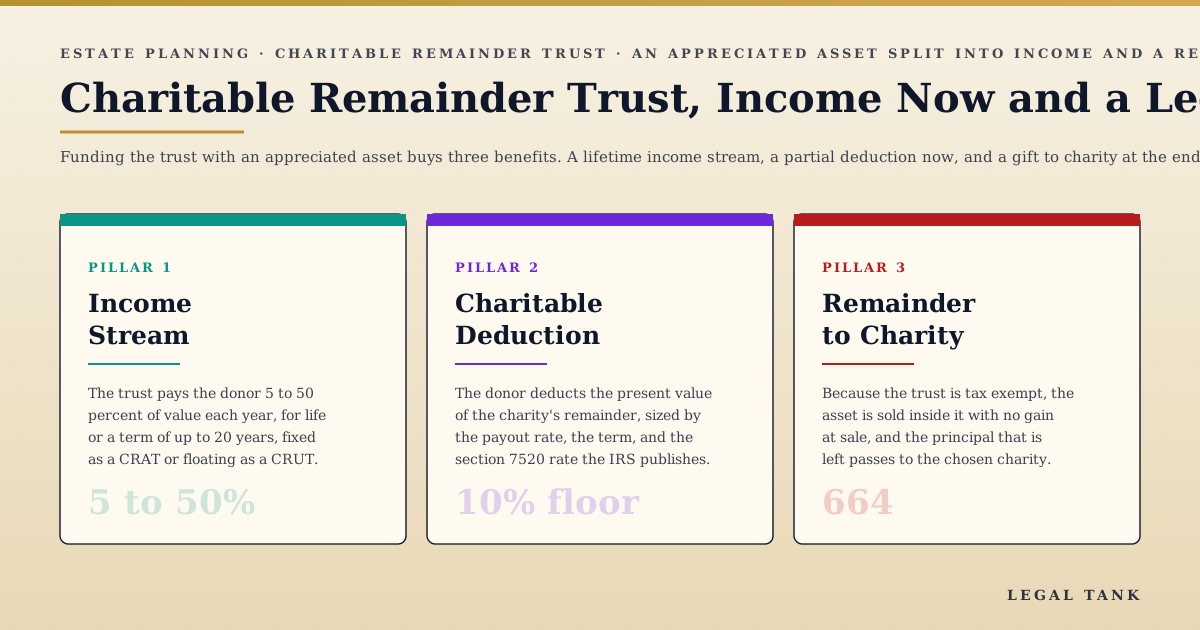
A charitable remainder trust works by splitting a single appreciated asset into two interests over time. The donor transfers the asset into an irrevocable trust and keeps an income interest: the right to receive a payment stream for life or for a fixed term of up to 20 years. Whatever is left when that interest ends, the remainder, passes to one or more charities. Because the trust is tax exempt under Internal Revenue Code section 664, the trustee can sell the appreciated asset inside the trust without an immediate capital gains tax, so the full pre-tax value stays invested and working.
Consider a donor who contributes long-held stock worth 1,000,000 dollars with a cost basis of 200,000 dollars into a 5 percent unitrust. Sold personally, the 800,000 dollar gain would be taxed first and only the after-tax proceeds could be reinvested. Inside the trust the shares are sold with no tax at sale, all 1,000,000 dollars stays invested, and in the first year the trust pays the donor 50,000 dollars, which is 5 percent of the value. The donor also takes a charitable deduction for the present value of the charity's remainder interest in the year of the gift.
A charitable remainder trust is one kind of irrevocable trust structure, and it usually sits alongside the rest of an estate plan rather than replacing it.
Charitable Remainder Annuity Trust vs Unitrust
A charitable remainder trust comes in two forms, and the choice between the annuity trust (CRAT) and the unitrust (CRUT) turns on one question: do you want a fixed payment or one that moves with the trust value. The table sets the difference out line by line.
| Dimension | Annuity Trust (CRAT) | Unitrust (CRUT) |
|---|---|---|
| How the payout is set | A fixed dollar amount, computed once as a percentage of the initial funding value. | A fixed percentage of the trust value, revalued every year. |
| Does the payment change | No; the same dollar figure every year for the life of the trust. | Yes; it rises when the trust grows and falls when it shrinks. |
| Additional contributions | Not allowed after the trust is funded. | Allowed; the donor can add more assets over time. |
| Inflation protection | None; the fixed payment loses purchasing power over time. | Built in when the trust grows, since the payout tracks the value. |
| Extra qualifying test | Must pass the 5 percent probability test that it will not exhaust. | No probability test; the percentage-of-value design self-corrects. |
| Best suited to | A donor who wants a predictable fixed check and no further gifts. | A donor who wants growth, inflation cover, and the option to add assets. |
Both forms sit under the same statutory ceiling: the annual payout must be between 5 and 50 percent of value, and the projected remainder to charity must be worth at least 10 percent of the amount funded. Those figures are set by the tax code, not by our drafting service.
The Charitable Remainder Trust Tax Deduction
The donor does not deduct the full value of the asset contributed. The deduction is the present value of the charity's future remainder interest, meaning the projected slice that will eventually reach charity, discounted back to today. It is computed at funding from three inputs: the payout rate, the term of years or the income beneficiary's age, and the section 7520 rate the IRS publishes each month. A lower payout rate, a shorter term, an older income beneficiary, and a higher 7520 rate each push the remainder value up and enlarge the deduction.
The tax code sets a floor: the remainder must be worth at least 10 percent of the amount contributed for the trust to qualify. So on the 1,000,000 dollar funding above, the deduction is always at least 100,000 dollars, and for an older donor at a modest payout rate it is frequently much more. This 10 percent minimum is a statutory qualifying rule, not a figure our service sets.
The deduction is claimed in the year of the gift. It is capped at a percentage of adjusted gross income that depends on the type of asset and the type of charity, and any amount that exceeds the cap carries forward for up to five more years. Modeling the deduction against the current 7520 rate is part of settling the structure before the trust is signed.
Charitable Remainder Trust Payout and Income Stream
The payout is the annual income the trust pays the beneficiary, and the tax code frames it at both ends. The rate must be at least 5 percent and no more than 50 percent of value each year, and the trust must still be projected to leave at least 10 percent to charity, so in practice most trusts land in the 5 to 8 percent range. In an annuity trust the rate fixes a dollar amount at funding; in a unitrust it applies to the trust's value as revalued each year, so the check floats with performance.
The income can run for one or more lifetimes or for a fixed term of up to 20 years. On the 1,000,000 dollar unitrust at 5 percent, the first-year payment is 50,000 dollars; if the trust grows to 1,100,000 dollars, the next year pays 55,000 dollars, and if it falls to 900,000 dollars, it pays 45,000 dollars. An annuity trust set at the same 5 percent would instead pay a flat 50,000 dollars every year regardless of how the investments perform.
Each distribution is taxed to the beneficiary under a four-tier ordering rule that carries out the trust's ordinary income first, then capital gain, then tax-exempt income, then a return of principal. That is the mechanism by which the deferred capital gain is recognized gradually over the payout years rather than all at once in the year of sale.
Who Should Use a Charitable Remainder Trust
The instrument rewards a specific profile: a highly appreciated asset, a wish to convert it into income, a desire to soften the capital gains on selling it, and genuine charitable intent. These are the situations where it fits best.
The founder with concentrated stock
A company founder or early employee sitting on a low-basis equity position can move shares into the trust, let the trustee diversify without an immediate capital gains bill, and draw an income stream instead of a lump sum.
The owner selling real estate
An investor holding appreciated real estate that would generate a large gain on sale can contribute the property, have the trust sell it tax exempt, and convert decades of appreciation into lifetime income.
The retiree seeking income
A retiree with a concentrated, low-yield position can trade it for a diversified income stream, take the up-front deduction, and reduce the estate, all while directing the eventual remainder to a chosen cause.
The donor with charitable intent
Someone who already plans to leave money to a charity can do it in a way that pays them back an income stream and a current deduction, rather than making an outright bequest that returns nothing during life.
It is the wrong tool for a donor who needs to keep full access to the principal, since the transfer is irrevocable and the remainder goes to charity rather than to heirs. Families who still want to provide for children often pair it with other structures, such as a trust for a disabled beneficiary or a creditor-protective spendthrift arrangement, so heirs are provided for outside the charitable plan.
Charitable Remainder Trust vs Charitable Lead Trust
A charitable lead trust is the mirror image of a charitable remainder trust, and the names say it plainly. In a remainder trust the charity is at the back: the donor or family takes the income stream first, and the charity receives what remains at the end. In a lead trust the charity leads: the charity receives the income stream for the term, and the family receives the remainder at the end. The two run the same cash flows in opposite order.
That reversal changes who each tool serves. A remainder trust suits a donor who wants lifetime income now, an up-front income tax deduction, and capital gains deferral on an appreciated asset. A lead trust suits a donor who does not need the income and wants to pass an asset to heirs at a reduced gift or estate tax cost, letting the charity's lead interest shrink the taxable value of what the heirs eventually receive.
For most individuals converting an appreciated asset into retirement income, the charitable remainder trust is the fit. The lead trust is a wealth-transfer tool for donors focused on moving value to the next generation rather than on drawing income themselves.
How to Set Up a Charitable Remainder Trust
Six steps take a charitable remainder trust from an appreciated asset to a funded, income-producing plan. The asset and the goal are fixed first, because they decide the form, the payout rate, and the deduction that follow.
- 1
Confirm the asset and the goal fit
The trust works best for a highly appreciated, low-basis asset held by a donor with real charitable intent and no need to reclaim the principal. Whether a CRAT or a CRUT fits is settled here, before any drafting begins.
- 2
Draft the trust instrument
The document names the donor, the trustee, the income beneficiary, and the charitable remainder recipient; fixes the payout rate and the term or measuring life; and is written to meet the section 664 requirements so the trust qualifies as tax exempt.
- 3
Name a trustee and the charity
A trustee, often a bank or trust company, administers and invests the assets and files the trust's returns. The donor names one or more qualified charities as remainder beneficiaries, and may keep the right to change which charity receives the remainder.
- 4
Value the deduction and run the tests
The remainder value is computed using the payout rate, the term or ages, and the section 7520 rate, and it must pass the 10 percent minimum remainder test, with a CRAT also passing the 5 percent probability test.
- 5
Fund the trust and sell inside it
The donor retitles the appreciated asset into the trust, and the trustee sells it inside the tax-exempt trust so no capital gains tax is due at sale. The pre-tax proceeds are reinvested to support the income stream.
- 6
Administer the payout and reporting
The trustee pays the annual income stream, tracks the four-tier character of each distribution, and files the trust's annual return. The remainder passes to charity when the term ends or the income beneficiary dies.
Part of the estate-planning stack: the broader irrevocable-trust structure it belongs to, the revocable living trust for lifetime flexibility and probate avoidance, and the full estate-planning overview that ties the pieces together. For donors whose goal is shielding wealth rather than giving it, the cluster also covers a creditor-protective asset protection trust and a trust built for long-term-care planning.
Charitable Remainder Trust: Common Questions
What is a charitable remainder trust?
How does a charitable remainder trust avoid capital gains tax?
What is the difference between a CRAT and a CRUT?
How large is the charitable remainder trust deduction?
Who should consider a charitable remainder trust?
Can a charitable remainder trust be changed or revoked?
Turn an Appreciated Asset Into Income and a Legacy
Tell us the asset, its rough value and basis, and the income you want. We return the right form, the payout rate, and the modeled deduction, drafted to your state law and the qualifying tax rules for you to execute before a notary.
Quotes return same business day on intakes received before 5 PM ET