Asset Protection Trust: Shielding Your Own Assets
Prepared by a licensed U.S. attorney
An asset protection trust is a self-settled irrevocable trust where the grantor is also a beneficiary, built to place the grantor's own assets beyond the reach of future creditors and lawsuits.
This page explains how a domestic asset protection trust works, which states allow one, how domestic and offshore versions compare, how it differs from an LLC, who it is for, and how to set one up so the protection actually holds.
Self-Settled · Seasoned · Statute-Backed
Protect your own assets, not a third party's
How an Asset Protection Trust Works
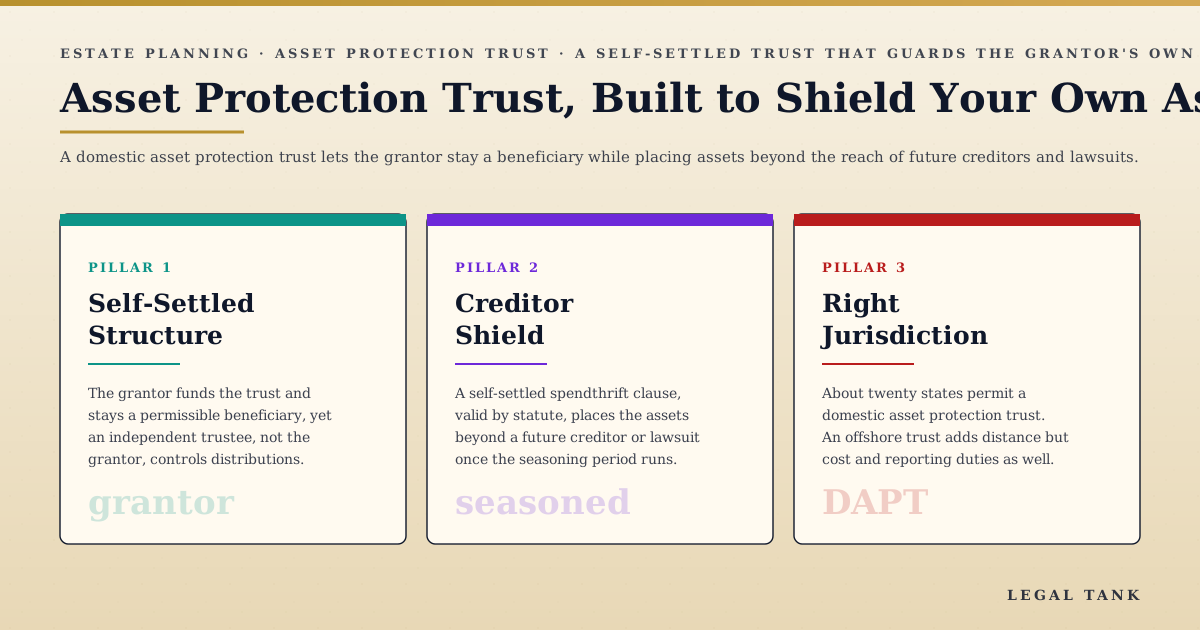
An asset protection trust works by letting the grantor give up ownership of assets without giving up the ability to benefit from them. The grantor transfers property to an irrevocable trust and names an independent trustee to hold and manage it. The grantor is listed as a discretionary beneficiary, so distributions can still flow back to them, but the trustee, not the grantor, decides when. That separation of ownership from control is what a court looks for when it decides whether the assets are truly out of the grantor's hands.
This is the self-settled case, and at common law it failed: the law would not let a person shield assets from creditors while still enjoying them. A domestic asset protection trust changes that result by statute. About twenty states now allow a self-settled trust to protect the grantor, provided the trust is irrevocable, uses a qualifying trustee, and is funded before any claim exists. The protection is a creature of that statute, which is why the state and the drafting decide whether it works.
Because a DAPT is a species of the broader irrevocable trust framework, it carries the same core trade-off: real protection in exchange for the grantor giving up direct control. What sets it apart is the single fact that the grantor can remain a beneficiary of a trust built to defeat the grantor's own future creditors.
Domestic vs Offshore Asset Protection Trust
Both structures aim at the same goal, keeping the grantor's assets out of a creditor's reach, and they diverge on distance, cost, and reporting. A domestic trust stays inside the United States legal system; an offshore trust moves the assets and the fight abroad. The table sets the difference out line by line.
| Dimension | Domestic Asset Protection Trust | Offshore Asset Protection Trust |
|---|---|---|
| Governing law | A United States state statute, so the trust and disputes stay in the domestic court system. | The law of a foreign jurisdiction such as the Cook Islands, Nevis, or Belize. |
| Reach of a US judgment | A US judgment still applies; protection rests on the state statute and the seasoning period. | Foreign courts generally do not enforce a US judgment, forcing a creditor to relitigate abroad. |
| Cost and complexity | Lower setup and maintenance cost, drafted to a single state statute. | Higher cost, a foreign trustee, and ongoing IRS reporting for foreign trusts. |
| Reporting burden | Ordinary domestic trust income reporting. | Additional federal filings for foreign trusts, with steep penalties for missing them. |
| Fraudulent-transfer exposure | A transfer to dodge a known creditor can be unwound under the Uniform Voidable Transactions Act. | Shorter foreign limitation periods and a higher burden on the creditor, though US transfer rules still matter. |
| Typical fit | Professionals and business owners seeking protection without foreign entanglement. | High-exposure grantors willing to trade cost and reporting for maximum distance from creditors. |
For most professionals and business owners, a domestic trust delivers meaningful protection without the cost and federal reporting an offshore structure carries. The right answer follows from the size of the exposure and the grantor's home state, which is a planning judgment rather than a menu choice.
Which States Allow Domestic Asset Protection Trusts
A DAPT can only be formed under a state that has passed a statute permitting a self-settled trust to protect the grantor. Roughly twenty states have done so. Nevada, Delaware, Alaska, and South Dakota lead the field because of strong statutes, short seasoning periods, and mature trust law, and a number of others, including Ohio, Tennessee, Wyoming, Utah, and Missouri, permit them as well.
A grantor does not have to reside in a DAPT state to use one, but forming a trust in a DAPT state from a home state that has no such statute raises a genuine question of whether the home state's courts will honor the protection. That conflict-of-laws risk is settled at planning, through the choice of state, the trustee, and where the assets sit, not by copying a form.
A representative selection of DAPT-statute states, not the complete list. Each statute sets its own trustee rule, seasoning period, and exception creditors, so the chosen state shapes how the trust is drafted.
The Limits Every DAPT Grantor Should Know
A DAPT is strong but not absolute, and honest planning names the edges. The statutory seasoning period varies by state: Nevada protects a transfer after two years, while Delaware and several others run closer to four, and the clock starts only when the asset is funded, not when the trust is signed. A transfer made while a claim is already known or foreseeable is a voidable fraudulent transfer under the Uniform Voidable Transactions Act no matter how much time passes.
The federal limit matters most. If the grantor files for bankruptcy, Bankruptcy Code section 548(e) lets a trustee reach a transfer into a self-settled trust made within ten years of the filing where it was made to hinder, delay, or defraud a creditor. That ten-year federal window sits on top of the state seasoning period, which is the central reason a domestic asset protection trust is funded early, well before any trouble is on the horizon, rather than as a reaction to a specific threat.
The Self-Settled Spendthrift Trust Behind a DAPT
The legal engine inside an asset protection trust is a self-settled spendthrift trust. A spendthrift clause restrains both voluntary and involuntary transfers of a beneficiary's interest, so creditors cannot reach it before the trustee distributes it. In an ordinary trust that clause protects a beneficiary who is someone other than the person who created the trust. A self-settled trust points the same clause back at the grantor, who is also the beneficiary.
At common law that self-directed protection was void as against public policy. A DAPT statute is precisely the legislative override that makes a self-settled spendthrift clause enforceable, subject to a seasoning period and a narrow set of exception creditors. Without a statute like that, dropping your own assets into a spendthrift trust protects nothing, because the assets are still treated as yours.
This is the sharp line between this page and its counterpart. If the goal is protecting a child's or grandchild's inheritance from that heir's creditors, the correct instrument is a third-party spendthrift trust for someone else's inheritance, which is strong in nearly every state and needs no special statute. An asset protection trust is the inward-facing, self-settled version that guards the grantor's own assets and depends on a DAPT or offshore regime to work.
Asset Protection Trust vs LLC
An LLC and an asset protection trust guard against different threats, and the strongest plans often use both. The distinction is the direction of the risk: an LLC contains liability that starts inside a business, while a trust shields personal assets from a claim aimed at the grantor.
What a Limited Liability Company Does
An LLC separates business liability from personal assets, so a claim arising inside the business generally stops at the company. Charging order protection also makes it hard for a personal creditor to seize an owner's membership interest and take over the entity.
Its limit is the reverse direction. A large personal judgment against the owner can still reach the value of the membership interest itself, because the LLC was built to protect the outside world from the business, not to protect the owner's stake from the owner's own creditors.
What an Asset Protection Trust Adds
A trust protects the assets it actually holds from the grantor's personal creditors, once it is properly seasoned. It covers exactly the gap an LLC leaves open, personal-capacity claims that reach past the business to the owner's wealth.
A common structure places the LLC's membership interests inside the asset protection trust. The LLC handles operational liability, and the trust handles personal-creditor exposure, so the two layers cover threats coming from opposite directions.
Who Needs an Asset Protection Trust
The common thread is exposure that insurance may not fully cover and wealth worth protecting, paired with the foresight to plan before any claim exists. The people below are the typical candidates, though the timing rule matters more than the label.
Physicians and Surgeons
Practitioners in high-liability specialties who face malpractice exposure that policy limits may not fully cover, and who want to protect personal wealth built over a career.
Business Owners and Founders
Owners who personally guarantee obligations or carry the risk of a business dispute spilling onto personal assets, and want a firewall around wealth already taken off the table.
Real Estate Investors
Landlords and developers exposed to tenant, contractor, and premises claims across multiple properties, often pairing the trust with entity structuring for each holding.
Professionals With Fiduciary Risk
Attorneys, accountants, engineers, and corporate officers whose work invites personal-capacity claims, seeking protection for assets accumulated before any dispute arises.
High-Net-Worth Families
Families protecting a concentrated position, a liquidity event, or an inheritance from future litigation and divorce exposure across the next generation.
Those Marrying Later or Again
Individuals coordinating a trust with a prenuptial agreement to keep separately owned wealth distinct, planned openly and well before any conflict.
Asset protection is one branch of a wider plan. If the aim is sheltering the family home from long-term-care costs rather than lawsuits, a Medicaid asset protection trust serves a different purpose, and the broader estate planning services tie a protection trust together with a will, powers of attorney, and the rest of the plan.
How to Set Up an Asset Protection Trust
Six steps take an asset protection trust from goal to funded, seasoned instrument. Timing leads: because the protection only reaches claims that do not yet exist, everything else follows from planning early.
- 1
Confirm the goal and the timing
An asset protection trust protects only against claims that do not yet exist. The planning starts long before any dispute, because a transfer made to escape a known or foreseeable creditor is a voidable fraudulent transfer, not protection.
- 2
Choose the statute state
The trust is formed under a domestic asset protection trust statute, or an offshore regime, matched to the grantor's exposure, home state, and tolerance for cost and reporting. That choice sets the trustee rule and the seasoning period.
- 3
Draft the self-settled spendthrift trust
The instrument names the grantor as a discretionary beneficiary, includes a statute-valid self-settled spendthrift clause, and defines a distribution standard that keeps the grantor from controlling the assets directly.
- 4
Appoint a qualifying trustee
Most DAPT statutes require an independent or in-state trustee, often a corporate fiduciary, so the grantor does not retain the kind of control that would let a creditor argue the trust is a sham.
- 5
Fund the trust and start the clock
Assets are retitled into the trust well ahead of any claim, because the statutory seasoning period runs from funding. Each transfer is checked for gift-tax reporting and fraudulent-transfer exposure.
- 6
Administer it as a real trust
The trustee keeps records, follows the distribution terms, and files the trust's returns. Treating the trust as genuinely separate from the grantor is what makes the protection hold if it is ever challenged.
Where this fits: the irrevocable trust hub covers the estate-tax and Medicaid angles, a creditor-protective trust for an heir handles the third-party case, and the full estate plan ties it all together.
Asset Protection Trust: Common Questions
What is an asset protection trust?
What is a domestic asset protection trust (DAPT)?
Does an asset protection trust actually protect assets from lawsuits?
Is an asset protection trust the same as a spendthrift trust?
Which states allow domestic asset protection trusts?
Do I need an asset protection trust or is an LLC enough?
Put Your Assets Behind a Real Shield
Tell us what you are protecting, the exposure you are guarding against, and your state. We return whether a domestic or offshore structure fits, the statute state, a self-settled spendthrift clause, and a funding plan, drafted for you to execute before a notary while there is still time for it to season.
Quotes return same business day on intakes received before 5 PM ET