Medicaid Asset Protection Trust: Shelter the Home and Savings
Prepared by a licensed U.S. attorney
A Medicaid asset protection trust is an income-only irrevocable trust that holds a home and savings so they are not counted for long-term-care Medicaid and are shielded from estate recovery, while the assets pass to heirs.
This page explains how a Medicaid asset protection trust works, the five-year look-back, what assets go in it, how it compares to a revocable living trust, who controls the assets, and how to set one up so it clears the look-back in time.
Home · Income-Only · Look-Back
Protection a revocable trust cannot give
How a Medicaid Asset Protection Trust Works
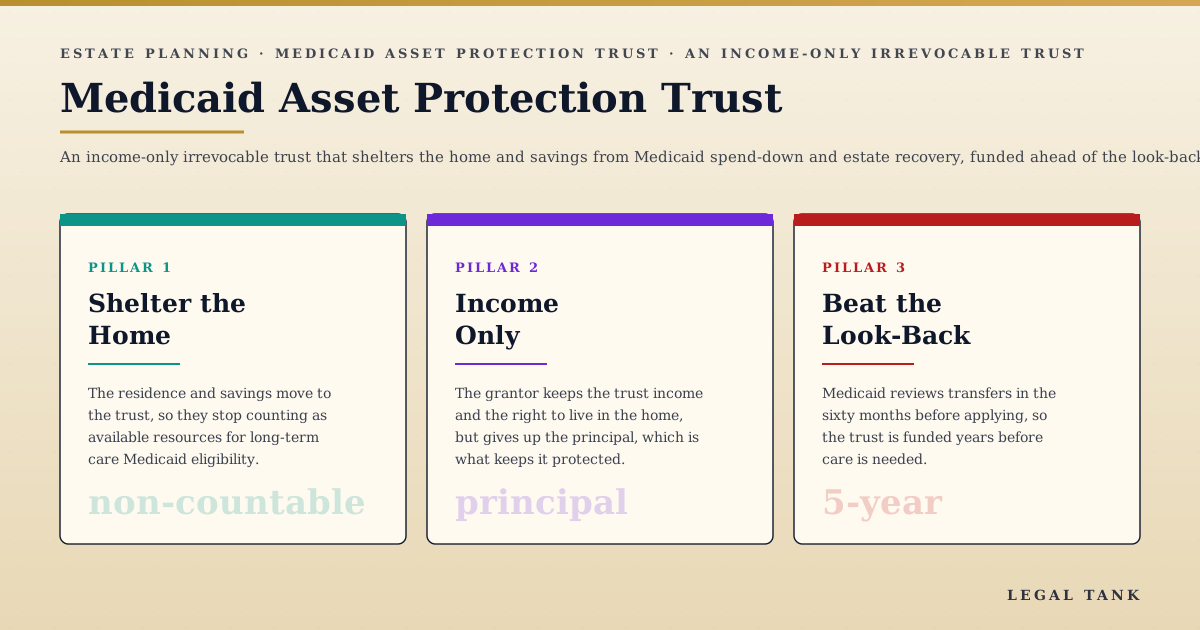
A Medicaid asset protection trust, or MAPT, works by moving the home and savings out of the grantor's ownership and into an irrevocable trust run by a separate trustee. Medicaid pays for nursing-home care only after an applicant has spent down almost everything they own, so assets left in the grantor's name would have to be exhausted first. Once the assets sit in the trust and the look-back window has passed, Medicaid no longer counts them as available resources, and the grantor can qualify without draining the house and savings.
The trust is drafted as income-only. The grantor keeps the income the trust assets produce and, commonly, a retained right to keep living in the home, but gives up the principal. That surrender of the principal is the whole point: because the grantor can no longer reach it, the law stops treating it as the grantor's available resource. The same feature also puts the assets beyond Medicaid estate recovery, the claim a state can make against a recipient's probate estate after death.
A MAPT is one kind of irrevocable trust, and it sits within a broader estate plan alongside a will, powers of attorney, and beneficiary designations that all need to point the same direction.
The 5-Year Medicaid Look-Back Period
The look-back is the reason a Medicaid asset protection trust has to be set up early. When someone applies for long-term-care Medicaid, the program reviews the transfers they made in the period before the application, which is sixty months, five years, in most states. Federal law sets this rule and each state administers it, so the specifics can vary. A transfer for less than fair value inside that window, including funding a MAPT, triggers a penalty period of ineligibility.
The penalty is calculated by dividing the value transferred by the state's average monthly private-pay nursing-home cost, and it does not start to run until the person is otherwise eligible and actually needs care. In other words, a gift made too close to the need for care can leave a family paying privately for months before coverage begins. The way to avoid it is simple in concept: fund the trust and let more than five years pass, so the transfer falls outside the look-back entirely and carries no penalty. To size the risk of a transfer made inside the window, our sister site LegalQuill offers a free Medicaid penalty period calculator that applies your state's divisor.
This is the planning window that a revocable arrangement can never open, and it is why the advice is always to act while the grantor is healthy rather than in a crisis. The exact look-back length, penalty divisor, and exempt-transfer rules differ by state, so the trust and its funding schedule are drafted to the grantor's own state Medicaid program.
What Assets Go in a Medicaid Asset Protection Trust
A MAPT holds the assets a grantor wants to preserve but will not need to spend, and it deliberately leaves out the assets they live on day to day and the ones that would be taxed on transfer. The table sets out the usual split.
| Asset | Treatment | Why |
|---|---|---|
| Primary residence | In the trust | The most common MAPT asset. Deeding the home to the trust, with a retained right to live there, shelters it from estate recovery while preserving the homestead's tax posture where the state allows. |
| Savings and investment accounts | In the trust | Non-retirement bank and brokerage accounts holding money the grantor will not need for daily living can be retitled to the trust, with the income paid out to the grantor. |
| A second home or land | In the trust | A vacation property or vacant land the grantor wants to keep in the family is a natural fit, since it is not needed for the grantor's own housing or income. |
| IRAs and 401(k)s | Usually stays out | Retiring an IRA into the trust triggers immediate income tax on the whole balance, so retirement accounts are almost always planned around separately rather than funded into a MAPT. |
| Everyday checking and a car | Stays out | The grantor keeps enough liquid funds and a vehicle to live on. Medicaid already exempts a car and a modest resource allowance, so these are left in the grantor's name. |
The through-line is that a MAPT protects only what it holds and only what the grantor can afford to give up the principal on. Which assets belong in the trust, and which are better left out or planned around, is decided at intake against the grantor's income needs and state rules.
Medicaid Asset Protection Trust vs Revocable Living Trust
Families often assume a living trust protects them from nursing-home costs. It does not. The two trusts serve different goals, and the difference comes down to whether the grantor keeps control of the principal.
| Dimension | Revocable Living Trust | Medicaid Asset Protection Trust |
|---|---|---|
| Can the grantor undo it | Yes, at any time; the grantor can revoke and reclaim the assets. | No; it is irrevocable, and the grantor gives up the principal. |
| Medicaid resource treatment | Fully countable; treated as the grantor's available resource. | Non-countable once the five-year look-back has run. |
| Estate recovery after death | Assets are exposed to the state's estate-recovery claim. | Assets titled in the trust are generally beyond estate recovery. |
| Probate avoidance | Yes, for assets funded into the trust. | Yes, for assets funded into the trust. |
| Access to principal | Full; the grantor can spend the principal freely. | None for the grantor; income only, principal preserved for heirs. |
| Best use | Probate avoidance and lifetime flexibility. | Long-term-care eligibility and preserving assets for heirs. |
If probate avoidance and lifetime flexibility are the goal rather than long-term-care protection, a revocable living trust is the right tool, and many families hold one alongside a MAPT for different assets.
Income-Only Trust: Who Controls the Assets
The phrase income-only describes exactly what the grantor keeps and what the grantor gives up. The grantor keeps the right to the income the trust assets produce, the interest, dividends, and rents, and usually a retained right to live in the home for life. What the grantor gives up is the principal: the ability to sell the trust assets and pocket the proceeds, or to demand the underlying property back. Giving up that principal is the precise act that makes the assets non-countable for Medicaid.
Because that control has to be genuinely surrendered, the grantor cannot serve as trustee. A separate trustee, most often an adult child or another trusted relative, holds and manages the principal under the trust terms. This is the hard part emotionally: a parent hands legal control of the family home to a child. Careful drafting softens it. The grantor can hold a limited power of appointment to change which heirs ultimately receive the remainder, keeping a measure of say without the kind of control that would make the assets countable.
So control splits three ways: the grantor holds the income and a home for life, the trustee holds and manages the principal, and the beneficiaries receive what remains. That division is what lets the plan protect the assets and still give the grantor a comfortable, familiar life in the meantime.
Medicaid Asset Protection Trust vs Irrevocable Trust
This comparison has a catch worth stating plainly: a Medicaid asset protection trust is a type of irrevocable trust, not an alternative to one. Every irrevocable trust runs on the same engine. The grantor gives up control, and that removes the assets from the grantor's taxable estate and shields them from creditors. The question is never irrevocable trust or MAPT, it is which purpose the irrevocable trust is drafted to serve.
A MAPT tunes the irrevocable structure for long-term-care eligibility. It is written income-only so the grantor keeps income but not principal, it retains a right to occupy the home, it is timed around the five-year look-back rather than an estate-tax deadline, and it is drafted to preserve the tax treatment of a primary residence where the state allows. Those are choices aimed at Medicaid, not at estate tax.
That distinction matters in practice, because an irrevocable trust drafted for a different goal can quietly fail Medicaid planning. A trust that gives the grantor the wrong retained powers, or that was built to minimize estate tax on a large estate, may leave assets countable or trip the look-back. When the goal is care planning, the irrevocable trust is drafted as a MAPT from the start. The related trust for a disabled beneficiary is another example of the same irrevocable engine tuned for an entirely different purpose.
How to Set Up a Medicaid Asset Protection Trust
Six steps take a MAPT from an early decision to a funded plan. The order is deliberate, and the first step, starting well before care is needed, carries more weight than any of the rest.
- 1
Plan early, before care is needed
Because the five-year look-back runs from the transfer date, the single most important step is starting years ahead. A MAPT set up while the grantor is healthy has time to clear the window before long-term care is ever required.
- 2
Draft the income-only trust
The instrument is written so the grantor keeps the income and a retained right to live in the home but gives up the principal. It names the grantor, an independent trustee, and the remainder beneficiaries, and is drafted to the grantor's state Medicaid rules.
- 3
Name an independent trustee
The grantor cannot be trustee of their own MAPT, so a trusted adult child or a professional fiduciary is appointed. The trustee holds and manages the principal under the trust terms while the grantor retains the income rights.
- 4
Execute before a notary
The grantor signs the trust instrument, which is notarized and, in some states, witnessed. No court or counsel of record is involved; the executed document creates the trust and sets the plan in motion.
- 5
Retitle the home and accounts
A new deed transfers the residence to the trust and the chosen accounts are retitled in the trust's name. Each transfer is dated and documented, because that date is when the look-back clock starts running.
- 6
Keep records and coordinate the plan
The trustee keeps clean records of the funding dates and any distributions, and the MAPT is coordinated with the rest of the estate plan, the will, powers of attorney, and beneficiary designations, so nothing works against it.
Part of the estate-planning stack: the irrevocable trust overview that covers the tax and creditor-protection side, a supplemental needs trust for a disabled loved one, a self-settled asset protection trust for shielding assets from lawsuits rather than long-term-care costs, and the wider estate-planning services that tie the will, powers of attorney, and trusts together.
Medicaid Asset Protection Trust: Common Questions
What is a Medicaid asset protection trust?
How does a Medicaid asset protection trust work?
What is the five-year look-back period?
Can I be the trustee of my own Medicaid asset protection trust?
Does a revocable living trust protect assets from Medicaid?
What is the difference between a MAPT and a regular irrevocable trust?
Protect the Home Before Care Is Needed
Tell us what you want to protect, the home, the savings, or both, and roughly when care might be needed. We return an income-only trust, the retained rights that fit your goals, an independent trustee structure, and a funding plan, drafted to your state law for you to execute before a notary.
Quotes return same business day on intakes received before 5 PM ET