Special Needs Trust: Protect an Inheritance and the Benefits
Prepared by a licensed U.S. attorney
A special needs trust holds assets for a person with a disability without counting as their own resources, so an inheritance or settlement can help them while their SSI and Medicaid stay intact.
This page explains what a special needs trust is, the first-party, third-party, and pooled forms, what the trust can pay for, how it compares to an ABLE account, and how to set one up so the benefits survive.
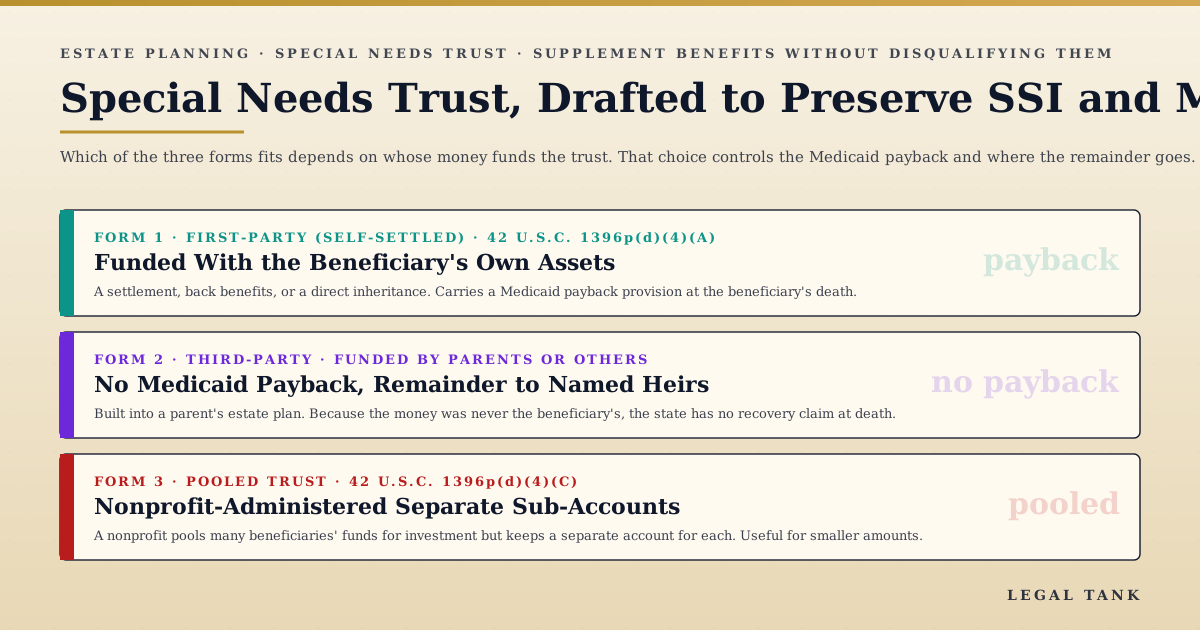
First-Party · Third-Party · Pooled
The funding source decides the form
What a Supplemental Needs Trust Does
A special needs trust, also called a supplemental needs trust, exists to solve one problem: means-tested benefits disappear when a person owns too much. Supplemental Security Income and Medicaid cut off once countable resources pass a low limit, currently $2,000 for an individual on SSI. Leave money to a disabled loved one outright and you can knock them off the very programs that pay for their care.
The trust threads that needle. Assets held in a properly drafted special needs trust do not count as the beneficiary's resources, so the benefits continue, while the trustee draws on the trust for the supplemental needs that public programs do not cover. The word supplemental is the key: the trust adds to benefits rather than replacing them, which is why the distribution standard is discretionary and never a plain support obligation.
A special needs trust is one kind of irrevocable trust, because only an irrevocable structure keeps the assets from counting against eligibility.
First-Party, Third-Party, and Pooled Trusts
Whose money funds the trust decides which form applies, and the form decides whether the state must be repaid at death. Getting this wrong is the most common and most expensive mistake in this area, so it is settled at intake.
First-Party · (d)(4)(A)
Self-Settled Trust
Funded with the beneficiary's own money, most often a personal injury settlement or a direct inheritance. Must be created before age 65 and must repay Medicaid from the remainder at the beneficiary's death.
Medicaid payback required
Third-Party
Parent-Funded Trust
Funded by parents, grandparents, or others with money that was never the beneficiary's. Built into the family estate plan, often as a standby trust that a pour-over will or life insurance funds at death.
No Medicaid payback
Pooled · (d)(4)(C)
Nonprofit Pooled Trust
A nonprofit pools many beneficiaries' funds for investment while keeping a separate sub-account for each. Supplies a professional trustee, which suits smaller amounts and families without an individual trustee.
Payback or charity retention
The creditor logic behind all three forms, that a beneficiary cannot reach or assign the trust principal, is the same logic a spendthrift trust uses to keep an heir's creditors out.
Special Needs Trust vs an ABLE Account
An ABLE account is the other tool for holding money without losing benefits, and it is worth understanding because the two are complements, not rivals. An ABLE account is a tax-advantaged savings account the beneficiary can usually control themselves, capped at an annual contribution tied to the gift exclusion, and open only to those whose disability began before a set age, which rises to 46 starting in 2026 under the SECURE 2.0 Act.
The trade-off is size. An ABLE account is simple and self-directed but limited by its contribution cap, which makes it a poor home for a large settlement or inheritance. A special needs trust has no contribution cap and can hold substantial principal, at the cost of needing a trustee and more administration. It also has no age-of-onset restriction.
Many families run both. The ABLE account covers everyday spending the beneficiary manages directly, and the special needs trust holds the larger principal a trustee administers under the supplemental-needs standard. Which mix fits depends on the amount involved and the age the disability began.
How to Set Up a Special Needs Trust
Six steps take a special needs trust from funding source to working plan. The funding source is fixed first, because it decides the form, the payback, and everything downstream.
- 1
Identify the funding source
Whether the money is the beneficiary's own (settlement, back benefits, direct inheritance) or a third party's decides the form: first-party with a Medicaid payback, or third-party without one. This is settled first.
- 2
Draft the trust to benefit rules
The instrument names the beneficiary and trustee, states a sole-discretion supplemental-needs distribution standard, and, for a first-party trust, includes the (d)(4)(A) payback. It is drafted so the assets stay non-countable.
- 3
Choose a benefits-literate trustee
The trustee must know SSI and Medicaid rules cold. A parent-trustee names a professional successor; smaller estates use a pooled-trust nonprofit as trustee under (d)(4)(C).
- 4
Execute and coordinate the estate plan
The grantor signs before a notary, and a third-party trust is coordinated with the will, any life insurance beneficiary designations, and relatives so no one leaves money to the beneficiary outright.
- 5
Fund the trust correctly
First-party trusts are funded with the beneficiary's assets; third-party trusts are often funded at the grantor's death. Nothing should pass to the beneficiary directly, which would count against benefits.
- 6
Administer without breaking benefits
The trustee pays vendors directly, avoids cash to the beneficiary, coordinates food and shelter distributions against SSI, and keeps records. Ongoing administration is where eligibility is kept or lost.
Part of the estate-planning stack: the irrevocable trust overview that covers the tax and asset-protection side, and a living trust for the revocable, probate-avoidance layer of the plan. Where the concern is an aging parent's own long-term-care costs rather than a disabled beneficiary's benefits, the Medicaid asset protection trust is the instrument that fits.
Special Needs Trust: Common Questions
What is a special needs trust?
What is the difference between a first-party and a third-party special needs trust?
What can a special needs trust pay for?
What is the difference between a special needs trust and an ABLE account?
Who can be the trustee of a special needs trust?
Does a special needs trust have to be irrevocable?
Provide for a Loved One Without the Cutoff
Tell us who the beneficiary is, where the funding comes from, and the benefits they receive. We return the right form, the distribution standard, and a funding plan, drafted to your state law for you to execute before a notary.
Quotes return same business day on intakes received before 5 PM ET