Spendthrift Trust: One Clause That Guards an Inheritance
Prepared by a licensed U.S. attorney
A spendthrift trust holds an inheritance so the beneficiary cannot sign it away and creditors cannot seize it before the trustee pays it out. The protection lives in a single spendthrift clause.
This page explains how a spendthrift trust works, what the spendthrift clause says, the asset protection it gives and where it stops, the self-settled variant, and how to set one up so the protection actually holds.
No Assign · No Attach · Until Paid
Protection lasts until the money is distributed
How Does a Spendthrift Trust Work?
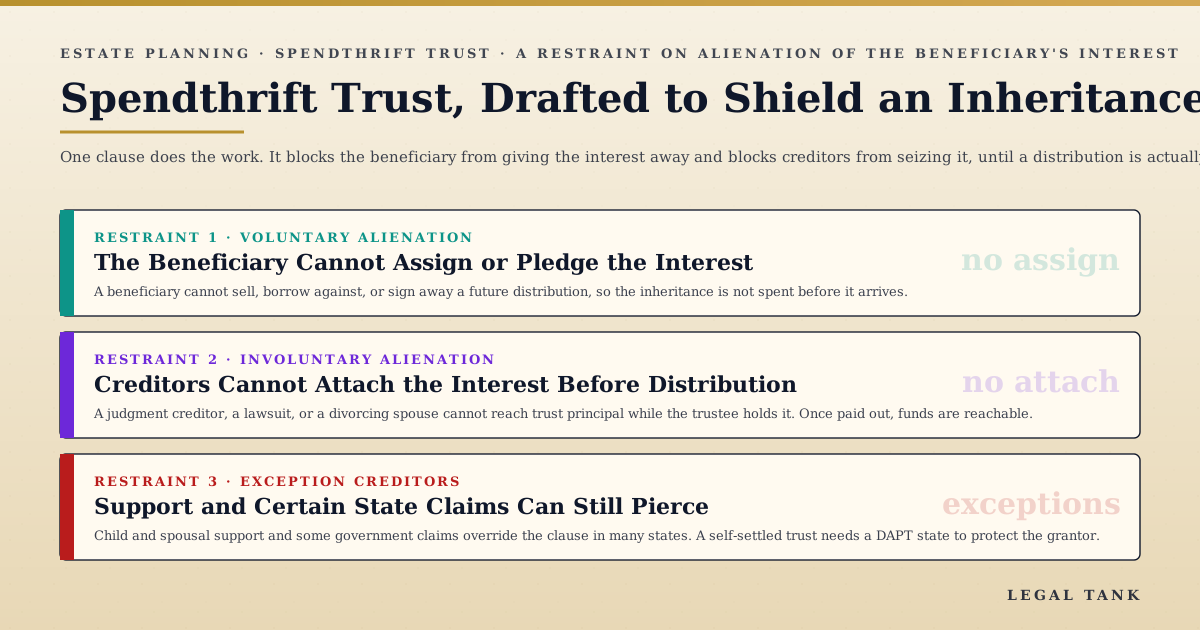
The mechanism is a restraint on alienation, a rule that the beneficiary's interest cannot change hands, in either direction, until the trustee actually distributes it. That single restraint has three practical faces.
Voluntary transfers
The Beneficiary Cannot Give It Away
The clause bars the beneficiary from assigning, selling, or pledging a future distribution. The interest cannot be spent, borrowed against, or signed over before it is actually paid out.
Involuntary transfers
Creditors Cannot Seize It
A judgment creditor, a personal-injury plaintiff, or a divorcing spouse generally cannot attach or garnish the beneficiary's interest while it remains in the trust. The trustee, not the creditor, controls the money.
Exception creditors
A Few Claims Still Get Through
Under Uniform Trust Code section 503, child and spousal support and certain government claims can pierce the clause in many states. And once assets are distributed, they lose the protection.
The spendthrift restraint is one tool within the broader irrevocable trust structure, and the same clause is what protects a special needs trust for an heir with a disability.
The Spendthrift Clause and What It Must Say
All of the protection rides on one provision. A spendthrift clause, also called a spendthrift provision, states that the beneficiary may not voluntarily or involuntarily transfer, assign, or encumber their interest, and that no creditor may reach that interest before it is distributed. Short as it is, this is the sentence a court parses when a creditor attacks the trust.
The wording is not decorative. Under Uniform Trust Code section 502, a spendthrift provision is valid only if it restrains both voluntary and involuntary transfers. A clause that blocks the beneficiary from assigning the interest but says nothing about creditor attachment fails the test, and a court can treat the trust as having no spendthrift protection at all. That is why the clause is drafted to the specific language the controlling state statute requires.
The illustrative provision below shows the shape of a compliant clause. The operative trust is always drafted to the beneficiary, the assets, and the governing state code.
ARTICLE VII. SPENDTHRIFT PROVISION
No beneficiary of any trust created under this instrument shall have the power to sell, assign, transfer, encumber, or in any manner anticipate or dispose of any interest in the trust or any income or principal payable therefrom before its actual distribution by the Trustee. No such interest, and no income or principal, shall be subject to the claims of any creditor of a beneficiary, nor to legal process, attachment, garnishment, or bankruptcy proceeding, nor to any voluntary or involuntary transfer, until the same has been paid into the hands of the beneficiary.
Illustrative only. The operative clause is drafted to the controlling state trust code and coordinated with the rest of the trust, because a court reads the exact language when a creditor challenges it.
Spendthrift Trust Asset Protection and Its Limits
For a third-party spendthrift trust, one a parent or grandparent creates for someone else, the protection against the beneficiary's creditors is strong in nearly every state. A lawsuit judgment, a business creditor, or a divorcing spouse of the beneficiary generally cannot reach the principal while the trustee holds it. This is the workhorse structure for leaving wealth to an heir who faces lawsuit risk or is not ready to manage a lump sum.
The protection has edges. Under Uniform Trust Code section 503, exception creditors, chiefly child support and spousal support, along with certain government claims, can pierce the clause in many states. And the shield ends at distribution: money in the beneficiary's pocket is fair game. So the trustee's discretion over timing is itself part of the protection.
The hardest case is the self-settled spendthrift trust, where the grantor is also a beneficiary. In most states a spendthrift clause does not protect a trust from the grantor's own creditors. Roughly a dozen and a half states permit a domestic asset protection trust, or DAPT, that does, but only when the trust is irrevocable, funded before any claim exists, and drafted to that state's statute. A transfer made to escape a known creditor is a fraudulent transfer a court can unwind, which is why timing and drafting decide whether the protection is real.
How to Set Up a Spendthrift Trust
Six steps take a spendthrift trust from decision to funded, creditor-resistant instrument. Whether it is third-party or self-settled is fixed first, because that answer changes the state, the statute, and the drafting.
- 1
Decide third-party or self-settled
A trust funded for someone else protects strongly in nearly every state. A self-settled trust, where the grantor is also a beneficiary, protects only in a domestic asset protection trust state and only when done carefully. This choice comes first.
- 2
Draft the spendthrift clause to the statute
The clause must restrain both voluntary and involuntary transfers to be valid under Uniform Trust Code section 502. It is drafted to the controlling state trust code, not copied from a generic form, because a court reads its exact words.
- 3
Appoint an independent trustee
The beneficiary cannot be the sole trustee if the protection is to hold. An independent individual or corporate trustee administers distributions under the trust standard, which is what keeps the interest beyond a creditor's reach.
- 4
Set the distribution standard
The document defines when and how the trustee may distribute, often a discretionary standard, so the trustee can withhold distributions while a beneficiary faces a claim and release them when it is safe.
- 5
Execute the irrevocable trust
The grantor signs before a notary, and the trust is drafted as irrevocable, or as a testamentary or living-trust provision that becomes irrevocable, because a revocable spendthrift trust protects nothing.
- 6
Fund before any claim arises
Assets are retitled into the trust well ahead of any lawsuit or creditor, since a transfer made to dodge a known creditor is a fraudulent transfer the court can unwind. Early funding is what makes the protection real.
Where this fits: the irrevocable trust guide covers the estate-tax and Medicaid angles, and a revocable trust handles probate avoidance while you are alive.
Spendthrift Trust: Common Questions
What is a spendthrift trust?
How does a spendthrift trust work?
What is a spendthrift clause?
Does a spendthrift trust protect against creditors?
What is a self-settled spendthrift trust?
Is a spendthrift trust revocable or irrevocable?
Leave the Money Protected
Tell us who the inheritance is for, the creditor or lawsuit risk you are guarding against, and your state. We return whether a third-party or self-settled structure fits, a statute-valid clause, and a funding plan, drafted for you to execute before a notary.
Quotes return same business day on intakes received before 5 PM ET