Share Purchase Agreement: How an SPA Is Structured, What It Covers, and When to Use APA Instead
A share purchase agreement is the principal contract used to transfer ownership of a private company by selling shares of the target entity from the existing shareholders to the buyer. The SPA fixes the purchase price, the share count and class being transferred, the representations and warranties each side gives, the indemnification mechanics if a rep turns out wrong, the covenants that govern conduct between signing and closing, and the conditions that must be satisfied before closing. Unlike an asset purchase agreement, which transfers only specific assets and liabilities on a schedule, a share purchase transfers the entire company including every contract, employee, license, and liability sitting on its balance sheet. The four legal elements of contract formation (offer, acceptance, consideration, and intent to be legally bound) appear on the face of every SPA, but the document's commercial weight sits in the reps, indemnification, and disclosure schedules that allocate deal risk between the parties.
Last updated 2026-05-12.
What a Share Purchase Agreement Is and How It Differs From an Asset Purchase Agreement
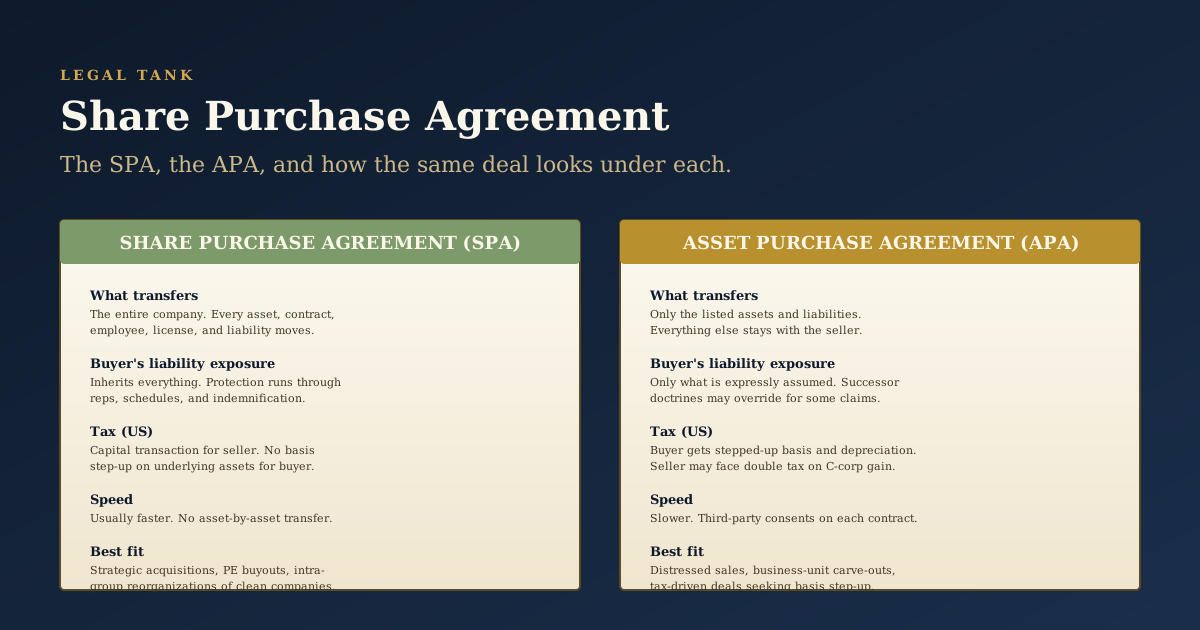
A share purchase agreement (commonly called an SPA or, in the United States, a stock purchase agreement) transfers ownership of a private company by transferring the shares of the target entity from the selling shareholders to the buyer. Once the SPA closes, the buyer owns the company, and the company continues to operate with every asset, contract, and liability it had the day before, now under new ownership. The SPA is the central legal artefact of any private M&A transaction and is typically the longest and most heavily negotiated contract in the deal.
An asset purchase agreement (or APA) takes a different shape. Instead of transferring the company itself, the APA transfers a defined list of assets and a defined list of assumed liabilities from the seller (which remains a separate legal entity) to the buyer. The buyer cherry-picks what comes across and leaves the rest behind. Most state successor-liability doctrines respect the APA structure for general contractual exposure, with carve-outs for fraudulent transfers, mere-continuation situations, and certain tax, environmental, and labor claims that travel with the assets even when the contract says they do not.
The choice between SPA and APA is not a drafting preference. It is a strategic decision that shapes deal speed, tax outcomes, third-party-consent requirements, and which side carries the legacy-liability tail. The next section walks through the four dimensions that typically drive the decision: liability allocation, tax treatment, closing speed, and operational continuity.
Doctrinal note
The contract-formation elements (offer, acceptance, consideration, mutual assent, capacity, and lawful purpose) under the Restatement (Second) of Contracts apply to an SPA the same way they apply to any other contract. For SPAs that transfer goods alongside shares (rare but not unheard of in carve-outs), the UCC section 2-201 statute of frauds writing requirement is satisfied on the face of the executed SPA.
When You Use an SPA vs an APA: Strategic Choice by Tax, Liability, and Speed
The strategic choice between a share purchase and an asset purchase turns on five dimensions that play out differently for buyer and seller. The grid below captures the practical trade-offs a corporate deal team works through before the first draft of the transaction agreement leaves the keyboard.
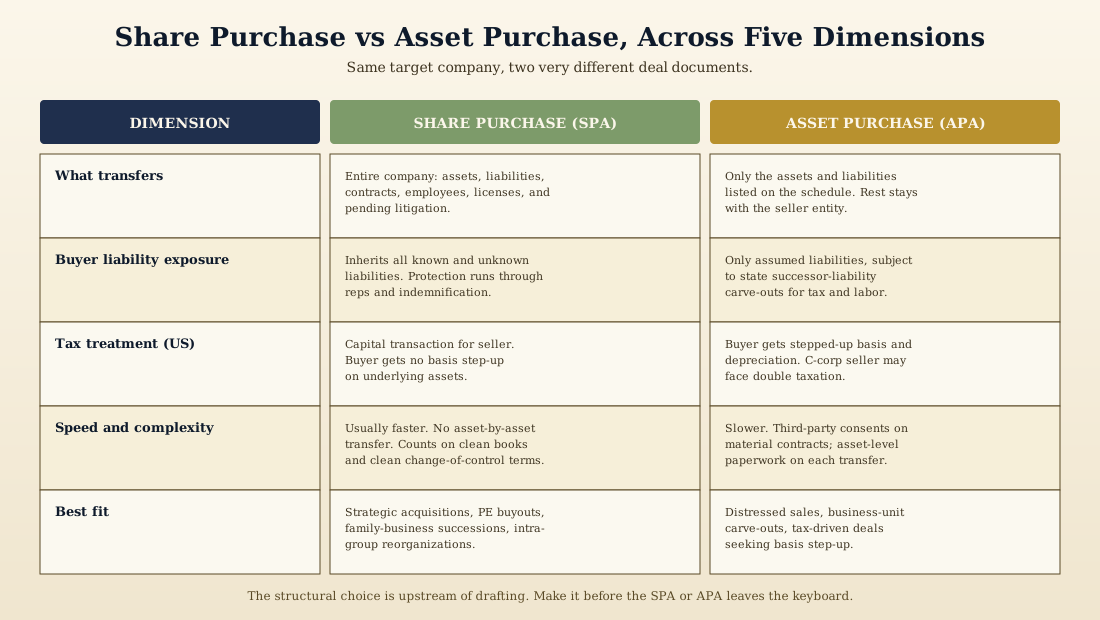
What transfers
Share Purchase Agreement
Every share of the target entity, and with it the whole company: assets, liabilities, contracts, employees, licenses, and litigation.
Asset Purchase Agreement
Only the specific assets and liabilities listed on the asset schedule. Anything not listed stays with the seller's existing entity.
Liability exposure for the buyer
Share Purchase Agreement
Inherits all known and unknown liabilities of the target company. Protection runs through reps, disclosure schedules, and indemnification.
Asset Purchase Agreement
Only the liabilities expressly assumed. Successor-liability doctrines in some states can override this for tax, environmental, and labor claims.
Tax treatment (US)
Share Purchase Agreement
Generally a capital transaction for the seller. Buyer does not get a step-up in basis on the underlying assets, which limits depreciation going forward.
Asset Purchase Agreement
Buyer typically gets a stepped-up basis in the acquired assets and the corresponding depreciation. Seller may face double taxation if the seller is a C-corporation.
Speed and complexity
Share Purchase Agreement
Usually faster to close because no individual asset transfer is needed. Counts on the company carrying clean books and clean third-party consents.
Asset Purchase Agreement
Often slower because each material contract may require third-party consent to assign, and asset-level transfers must be papered individually.
Best fit
Share Purchase Agreement
Strategic buyers acquiring an operating business, family-business successions, private equity buyouts of clean companies, and intra-group reorganizations.
Asset Purchase Agreement
Distressed sales, carve-outs of a business unit, buyers who want to leave legacy liabilities behind, and tax-driven deals seeking basis step-up.
Distressed sales and carve-outs of a single business unit almost always run as APAs because the buyer wants to leave legacy liabilities and unrelated contracts behind. Healthy private-company sales and intra-group reorganizations typically run as SPAs because the company has clean books, clean third-party consents, and the speed advantage matters. Tax-driven structuring (the buyer wants an asset basis step-up, the seller wants capital-gains treatment) can flip the choice in either direction; the SPA or APA is the wrapper, but the tax outcome is the headline number.
Eight Clauses Every SPA Carries, From Purchase Price to Closing Mechanics
A stock purchase agreement drafted for a real private M&A transaction runs eighty to one hundred and fifty pages of operative text, plus disclosure schedules and exhibits that often run longer than the agreement itself. Inside that volume, eight clauses carry the commercial weight. Every other clause is plumbing.
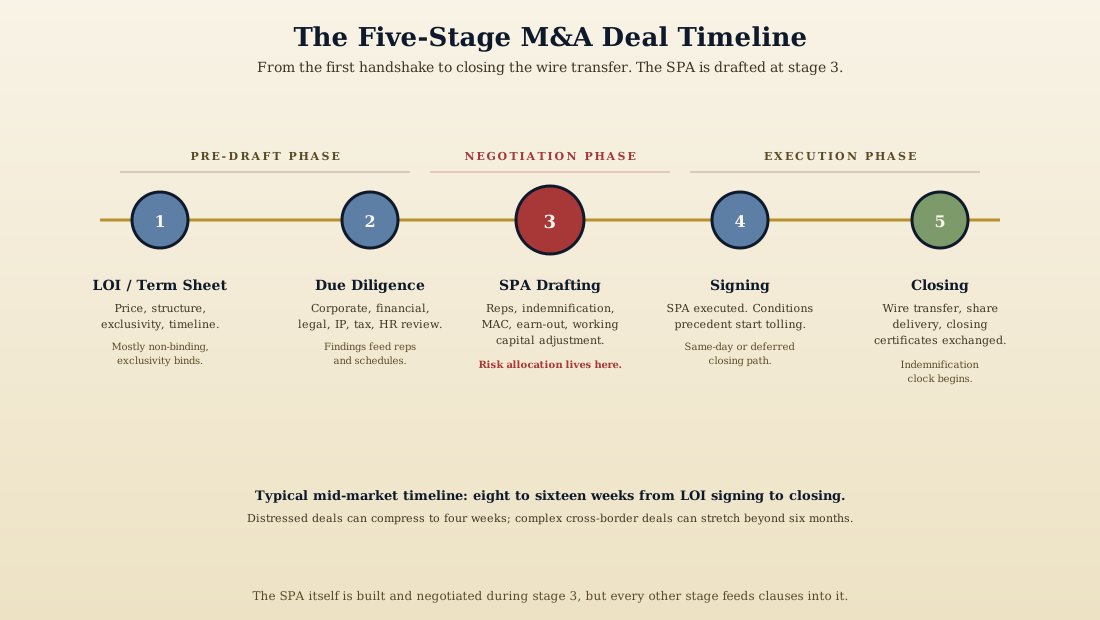
The Five-Stage M&A Timeline
01
Letter of Intent or Term Sheet
The parties sign a short, mostly non-binding LOI that fixes price, structure (share vs asset), exclusivity, and target timeline. The exclusivity and confidentiality provisions are usually binding; the rest sets the framework for the SPA.
02
Due Diligence
The buyer's deal team reviews corporate records, contracts, financials, tax filings, employee data, litigation, and IP. Findings flow into the disclosure schedules and may reshape the purchase price, reps package, or indemnification structure.
03
SPA Drafting and Negotiation
First draft typically comes from buyer's counsel. Negotiation focuses on the reps and warranties scope, indemnification caps and baskets, working-capital adjustment, MAC definition, and any earn-out mechanics. This is where the deal risk is allocated.
04
Signing
Both sides sign the SPA. For deals that close simultaneously with signing, closing deliverables are executed at the same table. For deferred closings, signing locks in the deal but closing is conditioned on the conditions precedent being met.
05
Closing
Conditions precedent are confirmed, the purchase price wire flows, share certificates or book-entry transfer documents are delivered, and the closing certificates and legal opinions are exchanged. Post-closing covenants and the indemnification clock begin running.
The Eight Operative Clauses
Parties and Recitals
Identifies each selling shareholder, the buyer, the target company, and the background of the transaction. Recitals do not create obligations on their own but anchor interpretive context for every clause that follows.
Purchase Price and Adjustments
Fixes the headline price, the form of consideration (cash, stock, deferred payments, earn-out), the working-capital adjustment mechanic, and any escrow holdback that secures the indemnification obligations.
Conditions Precedent
Lists every condition that must be satisfied before the buyer is obligated to close: regulatory approvals, third-party consents, accuracy of reps as of closing, no material adverse change, and any deal-specific items.
Representations and Warranties
Seller reps cover the company's corporate organization, capitalization, financial statements, contracts, employees, taxes, litigation, IP, and compliance. Buyer reps are narrower and cover the buyer's authority and financing. Most negotiated section of the entire SPA.
Covenants
Pre-closing covenants control conduct of the business between signing and closing. Post-closing covenants typically include non-compete, non-solicit, confidentiality, and cooperation on tax matters and any pending litigation.
Indemnification
Specifies the survival period of the reps, the cap on aggregate indemnification, the deductible (basket) before claims trigger, and the carve-outs (fraud, fundamental reps, tax) that may carry uncapped or longer-survival treatment.
Disclosure Schedules
Schedules attached to the SPA qualify each rep with the specific items the seller is disclosing to the buyer. A defect in the disclosure schedule is the single most common driver of post-closing indemnification claims.
Closing Mechanics and Boilerplate
Closing deliverables list, governing law, dispute resolution forum, notice provisions, integration clause, expense allocation, and termination rights if the deal does not close by the outside date.
Pricing Mechanism: Locked Box vs Completion Accounts
The working-capital true-up described in the purchase-price clause is one way to settle the final number, but two named pricing structures sit behind it. A locked box fixes the price at a locked-box date with no post-completion adjustment; completion accounts leave the price provisional and adjust it after closing on actual completion-date figures. The working-capital adjustment is a feature of the completion-accounts route. A pure locked box has no post-completion true-up at all, so the seller instead carries a leakage regime.
Locked Box
The price is fixed at a locked-box date, usually the date of the most recent audited or management accounts, with no adjustment after completion. The buyer takes the economic risk and reward of the business from that locked-box date forward. Because the price cannot move, the seller gives a leakage covenant: value must not leak out of the target to the seller or its connected parties between the locked-box date and closing, except for defined permitted leakage (agreed dividends, salaries, and similar items carved out in advance). The buyer recovers any prohibited leakage dollar for dollar.
Completion Accounts
The price is provisional at signing and is trued up after closing, once completion accounts are drawn to the actual closing date. The parties agree an accounting policy hierarchy, prepare the completion accounts, and adjust the price for the actual cash, debt, and working capital found as at completion. This leaves the economic risk with the seller until the completion date and typically produces a post-closing true-up payment in one direction, sometimes resolved by an independent accountant where the parties dispute the figures.
Tax Covenant and Transfer Costs
Separate from the tax warranties, an SPA carries a tax covenant (often documented as a stand-alone tax deed) under which the seller agrees to pay the buyer, on a dollar-for-dollar basis, for pre-closing tax liabilities of the target that were not provided for in the completion accounts. It shifts the pre-closing tax risk back to the seller whether or not a warranty was technically breached. Transfer costs also differ by structure: a share transfer attracts transfer taxes on the shares (stamp duty, or an equivalent share-transfer tax in many jurisdictions), while an asset deal attracts asset-level transfer taxes such as real-property transfer tax and sales tax on the assets that move.
Negotiation time on a typical mid-market SPA concentrates in the reps and warranties package, the indemnification cap and basket structure, and the disclosure schedules that qualify each rep. Everything else is heavily templated and moves quickly between counsel. For a templated starting point on the underlying contracting framework, see our LLC operating agreement template (for entities that need a baseline operating agreement alongside an SPA closing) or our NDA and confidentiality agreement template (for the diligence-phase confidentiality wrapper that usually precedes any SPA negotiation).
Where SPAs Break: Reps and Warranties, Indemnification Caps, and Disclosure Schedule Defects
M&A disputes overwhelmingly resolve through indemnification claims, reps-and-warranties insurance claims, and earn-out disputes, not full-blown court trials. The patterns below are the five recurring failure modes that drive post-closing fights on the SPA, and that any breach-of-contract demand letter drafted for M&A indemnification work has to anticipate.
Reps and Warranties Too Narrow
Sellers push for tightly bounded reps that survive only briefly after closing. Buyers want broad reps with longer survival. An SPA carrying narrow reps with a short survival window leaves the buyer holding undisclosed liability risk with no contractual recourse once the survival period closes.
Indemnification Cap or Basket Mis-Calibrated
If the cap is too low relative to the deal value, the buyer's recovery on any indemnification claim is capped before it makes the buyer whole. If the basket (deductible) is too high, individual claims fall under the floor and are non-recoverable. Both mis-calibrations shift more risk than the deal economics priced for.
Disclosure Schedule Gaps
Every rep that is not qualified by the disclosure schedule is given absolutely. A schedule that omits a pending lawsuit, a customer-concentration concern, an off-balance-sheet liability, or a known regulatory issue exposes the seller to indemnification claims for items the seller actually knew but did not surface.
Material Adverse Change Definition Drift
The MAC clause lets the buyer walk away if a material adverse change occurs between signing and closing. Boilerplate MAC language carries court-tested exclusions (industry-wide events, macro conditions, changes in law) that may leave the buyer with no exit route when adverse events actually hit.
Earn-Out Calculation Ambiguity
Earn-outs tied to post-closing performance turn on the definition of revenue, EBITDA, or another metric. An SPA that leaves accounting policies vague, or that does not address buyer conduct affecting the metric, creates the most common M&A litigation pattern: post-closing earn-out disputes that drag on for years.
The Warranty Limitation Suite
A seller never gives warranties without limits. Four interlocking limitations cap warranty exposure, and a buyer reads them as one package because they move risk together.
De minimis
A per-claim floor. Any single warranty claim below the de minimis figure is disregarded entirely and does not count toward the threshold. It screens out trivial, nuisance-level claims.
Threshold (basket)
An aggregate floor. The buyer cannot claim until the total of all qualifying claims (each above the de minimis) exceeds the threshold. On a tipping basket the seller then pays the whole amount from the first dollar; on a deductible basket the seller pays only the excess above the threshold.
Cap
A ceiling on aggregate seller liability, usually stated as a percentage of the purchase price. General commercial warranties carry a lower cap; fundamental warranties (title to the shares, capacity, authority) and the tax covenant are commonly capped at or near the full purchase price.
Time limits
A survival window within which a claim must be notified. General commercial warranties run for a shorter period (often twelve to twenty-four months, long enough for one audited set of post-closing accounts). Fundamental, title, and tax warranties survive far longer, with tax claims typically tracking the statutory assessment period.
Disclosure Letter vs Disclosure Schedule
In many deals the seller qualifies the warranties through a disclosure letter rather than, or alongside, the numbered schedules bolted to the agreement. The letter works in two layers. General disclosure deems the contents of defined public registers and the data room disclosed against every warranty. Specific disclosure flags a named fact against a named warranty. Where a matter is fairly disclosed, the relevant warranty is read subject to that disclosure, so the buyer cannot later bring a warranty claim for the disclosed fact. Proper disclosure defeats the claim and caps the seller's liability. Anything the seller knows but leaves out of the disclosure letter stays inside the warranty given absolutely and travels straight into post-closing indemnification exposure. For the governance document that sits alongside an SPA once the buyer holds the shares, see our shareholder agreement guide.
Drafting and review
An SPA carrying any of the five defects above is a templated contract pretending to be a deal document. Have the SPA drafted around your specific transaction, or have the draft the other side has put on the table reviewed before you sign it. The indemnification clock starts running at closing, and the clauses that look standard are the ones that move the money in a dispute.
Frequently Asked Questions
What is a share purchase agreement?
Who signs a share purchase agreement?
Can I write my own purchase agreement?
What are the disadvantages of share purchase?
What is the difference between locked box and completion accounts?
How does a disclosure letter limit warranty claims?
Ready to draft or review your SPA?
Tell us about the transaction structure, the target company, and where you are in the M&A timeline. We will scope the work and respond with the next step.