Contract Templates for Every Situation
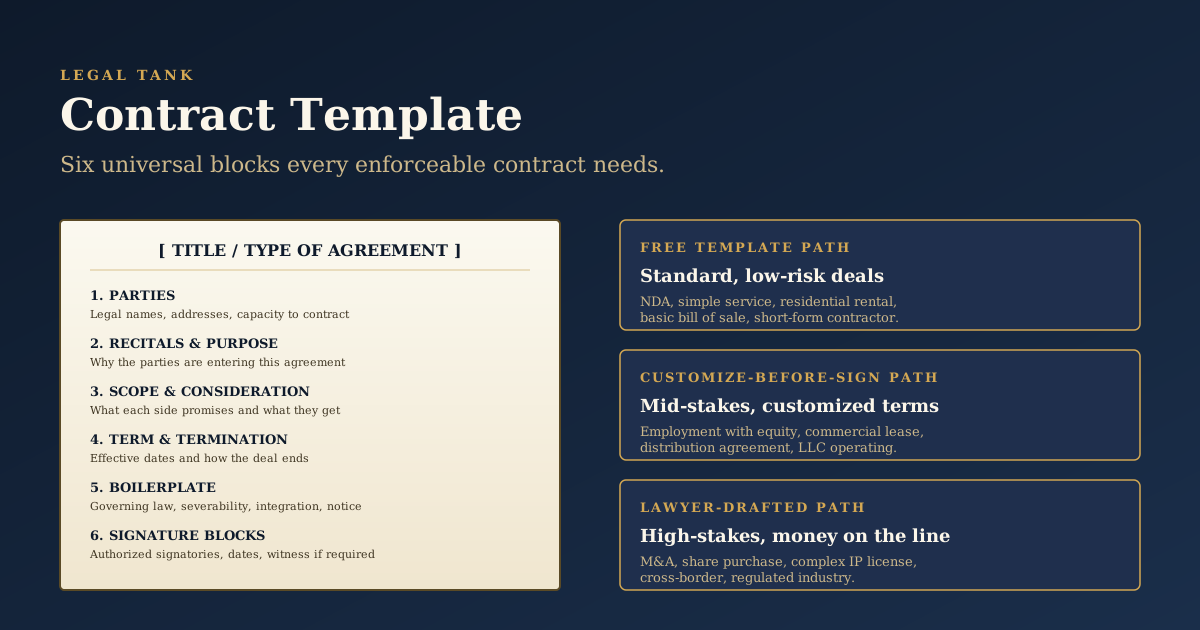
A contract template is a reusable document scaffold that carries the universal structural blocks every binding agreement needs (parties, recitals, consideration, scope, term, governing law, signatures) and leaves the deal-specific terms blank for the parties to fill in. The template removes the heavy structural drafting from each new deal so a contracting party can move quickly without re-inventing the scaffold. The four legal elements that make any contract binding (offer, acceptance, consideration, and intent to create legal relations) live inside the scaffold, and the customization work happens at the parties / scope / term / signature blocks. This pillar walks through what a contract template is and when it fits, catalogs the eight most-used templates with links into each, sets out the seven-block customization checklist every templated contract needs before signing, and closes on the five enforceability defects that take a templated contract out of legal force.
What a Contract Template Is and When You'd Use One
A contract template is the reusable scaffold of a contract: the structural sections every binding agreement carries, drafted once, with the deal-specific terms left blank for each new transaction. The scaffold satisfies the legal elements of formation (offer, acceptance, consideration, and intent to create legal relations under the Restatement (Second) of Contracts), while the deal-specific blanks (the parties, the dollar amount, the scope of work, the term, the governing-law state) are filled in fresh for every signing. A well-drafted template collapses the drafting time on a recurring deal type from hours to minutes, and shifts the contracting party's attention from structural drafting to the deal terms that actually matter.
The Full Set of Elements a Valid Contract Needs
Beyond the offer, acceptance, and consideration that most drafters focus on, a valid contract needs two further elements a template cannot supply on its own: capacity and a lawful purpose. Capacity means each party is legally competent to contract, an adult of sound mind, or an entity acting through a person with authority to bind it. A contract signed by a minor, by a person who lacks mental capacity, or by someone with no authority to bind the entity is voidable. Legality means the subject matter and purpose of the agreement are lawful; a contract to perform an illegal act, or one that violates public policy, is unenforceable no matter how carefully the scaffold is drafted. The intent element is more precisely described as mutual assent, the meeting of the minds: both parties must understand and agree to the same material terms, which is why clear, unambiguous drafting at the scope and consideration blocks is what proves assent if the deal is later contested.
When a Template Is the Right Starting Point
Contract templates work best when the underlying transaction is well-understood, repeatable, and not high-stakes by dollar value or business risk. A small business that signs a dozen similar service agreements a year benefits from a single calibrated template that has been reviewed by counsel once, customized at the seven blocks below for each new engagement. A landlord who rents the same residential unit on similar terms benefits from a single lease template anchored to the state landlord-tenant act, with the new tenant's name and rent figure filled in. An employer with a stable employee classification benefits from one offer-letter and one confidentiality-and-IP-assignment template applied to every new hire.
When a Template Is Not Enough
Templates are not the right starting point for high-dollar, high-risk, or first-of-its-kind transactions. A seven-figure acquisition, a complex licensing deal that turns on intellectual-property carve-outs, a partnership formation where the parties' contributions are asymmetric, or any contract with a counterparty whose counsel will mark up the draft heavily, all benefit from a bespoke drafting pass rather than a templated starting point. The rule of thumb practitioners use: if the deal-specific risk or dollar figure is material enough that the parties would litigate over the terms if the deal broke down, the contract should be drafted to the transaction rather than templated to the category. For sales of goods that fall under UCC section 2-201 (the statute of frauds for sales of goods over five hundred dollars), the writing must contain the quantity term and be signed by the party against whom enforcement is sought; a template that omits the quantity or the signature line fails this threshold formality.
Free Versus Lawyer-Reviewed Templates
Free contract templates are available across the web, from legal-form publishers, state bar association websites, and university small-business clinics. The variation between free templates is significant: some carry state-specific calibration and modern language, others carry outdated boilerplate that has not been updated to reflect recent state statutes or appellate decisions. The pillar-grade workflow is to start from a credible free template, customize at the seven blocks identified in the checklist below, and have a contract attorney review the customized version before signing. The review step is where most enforceability defects are caught. For a full drafting engagement on a high-stakes or unfamiliar transaction, the contract drafting service for professionally built agreements calibrated to your state and deal covers the full drafting build from intake through executed package.
Choosing the Right Template by Situation
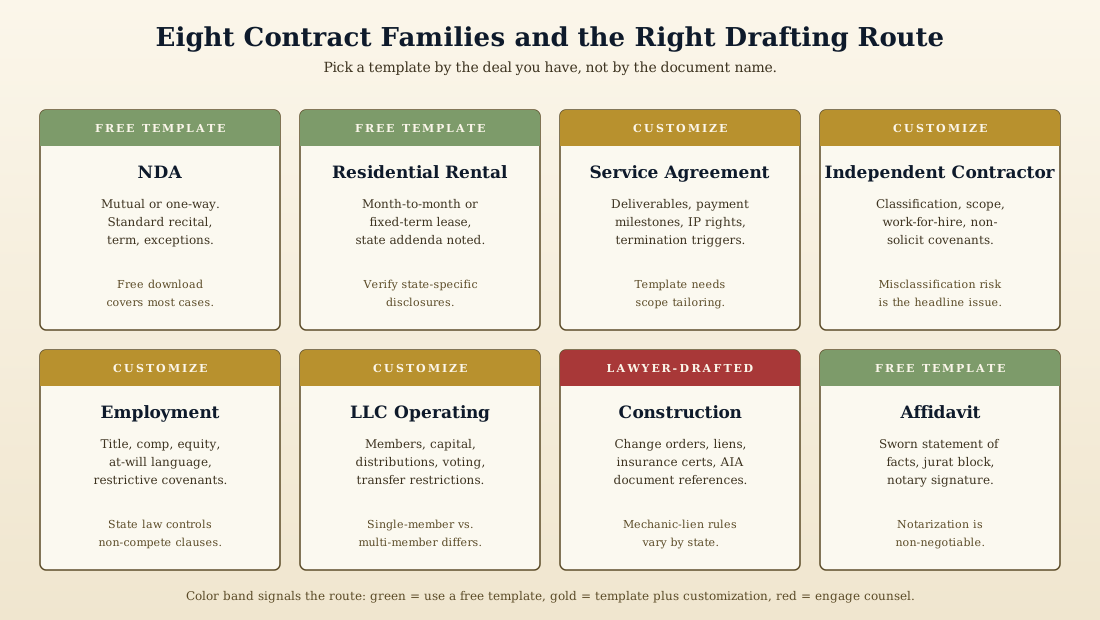
The eight contract templates below cover the instrument categories that account for the majority of small-business and personal contracting volume. Each card links into the instrument-specific child template page where the full document body lives. The same universal scaffold runs through every entry: only the deal-specific clauses differ by category.
Employment Contract Template
Salary or hourly compensation, at-will status, confidentiality, intellectual-property assignment, non-compete (where state law permits), and severance terms.
professional employment contract draftingNDA / Confidentiality Template
Mutual or one-way confidentiality, definition of confidential information, permitted disclosures, term of confidentiality, residual-knowledge clause, and remedies.
NDA and confidentiality agreement templateService Agreement Template
Scope of work, deliverables, milestones, payment schedule, change-order process, intellectual-property ownership, indemnification, and termination for convenience.
service agreement drafting from templateLease Agreement Template
Premises description, monthly rent, security deposit, term and renewal, maintenance obligations, default and remedies, and state-specific disclosure schedules.
free residential rental agreement templateIndependent Contractor Template
Statement of work, fixed or hourly rate, payment terms, intellectual-property assignment, contractor classification language, and indemnification.
independent contractor agreement draftingLLC Operating Agreement Template
Member capital contributions, allocation of profits and losses, management structure, member voting, transfer restrictions, and dissolution procedure.
LLC operating agreements templateAffidavit Template
Affiant identification, sworn-statement preamble, numbered factual paragraphs, jurat block, notary signature line, and exhibit attachment protocol.
sworn affidavit templateConstruction & Contractor Template
Project scope, materials and labor allocation, lien-waiver schedule, change-order procedure, warranty terms, and dispute-resolution sequence.
construction contract draftingCategories Not Listed
The catalog above covers the most-used template categories. For instrument types not listed (purchase agreements for real property, asset purchase agreements, settlement agreements, stock purchase agreements, franchise agreements, distribution agreements, joint-venture agreements), a custom drafting build is usually the right path because each of those instrument types carries category-specific risk allocation that does not template well. For professionally drafted demand and litigation work when a contract has been breached on either side, the breach-of-contract attorney pillar walks through the upstream enforcement track.
Related Templates and Guides
Several of the instrument categories above, and ones adjacent to them, have dedicated pages that go deeper than a single catalog card. For a two-owner or multi-owner business, the partnership agreement template and the LLC operating agreement template set out ownership, capital, and management terms. For confidentiality, the NDA and confidentiality agreements cover mutual and one-way structures. For hired-work relationships, the professional services contract fits agency and consulting engagements, while the guides on what an independent contractor agreement is and what a service agreement is explain the classification and scope choices behind those templates. For a one-time sale of goods or a vehicle, the guide on what a bill of sale is walks through the transfer-of-title mechanics.
What to Customize in Every Template Before You Sign
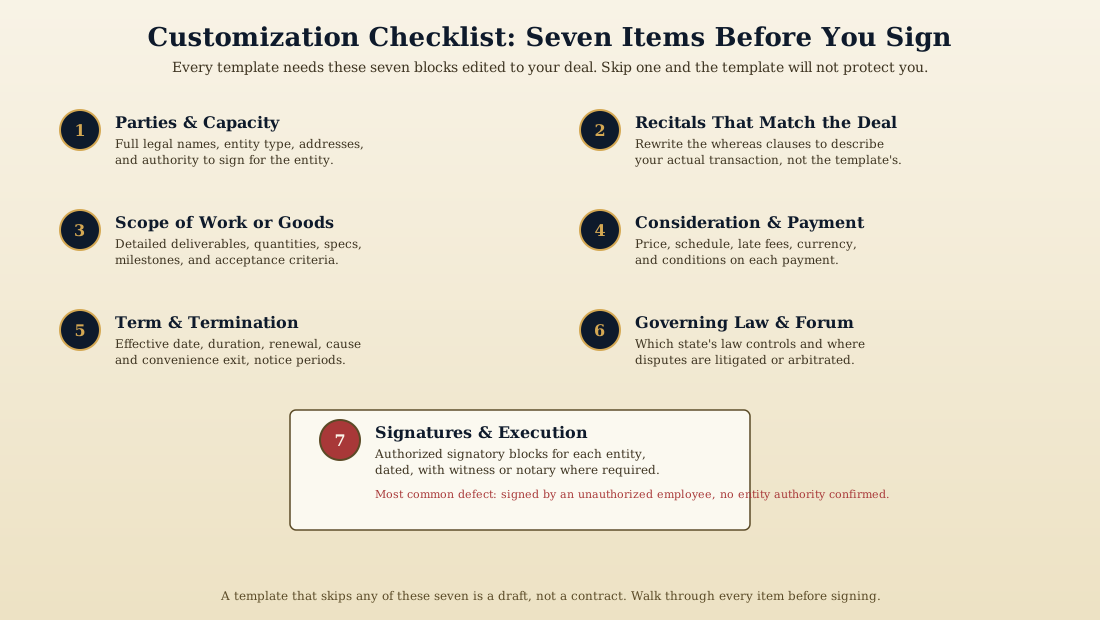
Every contract template, no matter how well-drafted, carries placeholder language that must be replaced with deal-specific terms before signing. The seven-block checklist below identifies the universal customization points. Walk each block in order and confirm the language matches the transaction. If any block remains generic, the template is not yet ready to sign.
- 01
Parties Block
Replace the placeholder party names with each party's full legal name and address. For entities, use the exact legal name as registered with the state (Acme Holdings, LLC, not Acme), and identify the signatory's title (CEO, Managing Member). Mismatched names are one of the most common enforceability defects.
- 02
Recitals (the WHEREAS Clauses)
Rewrite the background recitals to match the actual transaction. The recitals do not create legal obligations on their own, but courts read them to understand intent. A boilerplate recital that does not match the deal can be used against you to argue ambiguity in operative clauses.
- 03
Scope of Work or Subject Matter
Replace the templated scope with the precise work, goods, rights, or property being exchanged. Vague scope language (services as agreed, work as needed, customary deliverables) is the single biggest source of contract disputes. Specify deliverables, quantities, formats, and acceptance criteria.
- 04
Consideration and Payment Terms
Fill in the dollar amount (or describe the non-monetary consideration), payment schedule, invoice mechanics, late-fee calculation, and any retainer or deposit structure. For sales of goods over five hundred dollars, the price term is required in writing under UCC section 2-201 (statute of frauds).
- 05
Term, Renewal, and Termination
Set the effective date, expiration date, any auto-renewal language, and the termination-for-cause and termination-for-convenience clauses. Many template defaults carry indefinite auto-renewal that the parties did not actually negotiate; surface every renewal trigger and confirm it matches the deal.
- 06
Governing Law and Dispute Resolution
Select the state whose law governs the contract and the forum (court or arbitration) where disputes resolve. A template carrying Delaware governing law that was drafted for a Texas deal can route disputes into the wrong court and trigger jurisdiction motions that delay resolution by months.
- 07
Signature Block, Date, and Witness Lines
Match the signature block to the parties block. For entities, the signatory signs in their representative capacity (By: [Name], Its: [Title]). Some instruments require notarization or witness signatures under state law (deeds, durable powers of attorney, wills); the template should include those lines and your jurisdiction should be confirmed before signing.
Boilerplate and Miscellaneous Clauses to Confirm
Below the seven core blocks, every contract template carries a set of boilerplate (or miscellaneous) clauses that read as filler but decide how the contract behaves under stress. Do not delete them without understanding each one. A force majeure clause excuses performance when an event outside either party's control (natural disaster, war, government order, and in many modern drafts an epidemic or pandemic) makes performance impossible or impractical; confirm the trigger list and the notice and termination mechanics match the risk. A severability clause keeps the rest of the contract in force if one clause is struck down. An entire-agreement (integration) clause makes the signed document the complete deal and blocks a party from relying on prior emails or oral promises. An assignment clause controls whether either party can transfer the contract to a third party. A notice clause fixes how and where formal notices must be delivered to count. A waiver clause prevents a one-time excused breach from becoming a permanent give-up of the right. An amendment clause requires changes to be made in a signed writing. A counterparts clause, covered below, lets the parties sign separate identical copies. Read each of these against your deal rather than accepting the template default.
How to Sign and Execute Your Contract
Most business contracts do not need to be signed on paper. Under the federal Electronic Signatures in Global and National Commerce Act (ESIGN Act) and the Uniform Electronic Transactions Act (UETA), which nearly every state has adopted, an electronic signature carries the same legal effect as a handwritten one, and a contract cannot be denied enforceability solely because it is in electronic form. A typed name, a signature drawn on a touchscreen, or a click-to-sign through an e-signature platform all qualify, as long as each party intends to sign and consents to doing business electronically. A narrow set of documents sits outside ESIGN and UETA and still calls for a wet-ink original, including wills, certain trust instruments, and some family-law and court filings; those are the exceptions, not the rule.
Where the parties sign in different places or at different times, a counterparts clause lets each party sign a separate identical copy, and the signed copies together form one agreement. Notarization is not an element of contract formation and most agreements do not need it; it is required only for specific instruments such as deeds, durable powers of attorney, and documents recorded with a county office. Witness signatures work the same way: they are a state-law formality for a narrow set of instruments (wills, and in some states deeds), not a general contract requirement. Confirm your instrument type and governing-law state before assuming a signature alone is enough.
Five Mistakes That Make a Templated Contract Unenforceable
A templated contract that carries any of the five defects below can be set aside in whole or in part if the other side later contests enforcement. The defects below are the ones courts most commonly accept; the customization checklist above is designed to surface each of them at the blocks where they originate.
Missing or Vague Consideration
If one party is not giving anything of value, the contract is missing the consideration element and is not enforceable. Vague consideration (services as needed, support when requested) creates the same defect. Every template must show what each party is exchanging in concrete terms.
Statute of Frauds Defects
Certain contracts must be in writing and signed to be enforceable: sales of goods over five hundred dollars under UCC section 2-201, real-property transfers, contracts that cannot be performed within one year, and suretyship promises. A template that does not capture the signed-writing requirement, or that is signed only by one party where two signatures are required, fails the statute of frauds.
Defective Signature Authority
An employee who signs on behalf of a corporation without actual or apparent authority does not bind the corporation. Templates that do not surface the signatory's title and authority create a defect that the non-signing entity can later invoke to escape the deal. Confirm the signer holds the role the template names.
Mismatched Governing Law and Forum
A template carrying a governing-law clause for the wrong state (or a forum-selection clause for the wrong court) routes any future dispute into the wrong jurisdiction, triggers motions to dismiss or transfer, and can result in the contract being interpreted under unfamiliar state law. Update both clauses to match the deal's actual home jurisdiction.
Unconscionable or Ambiguous Terms
Templates carrying one-sided indemnification, attorney-fee-shifting, or arbitration clauses that no reasonable party would freely accept can be set aside as unconscionable. Ambiguous clauses are construed against the drafter under the contra proferentem doctrine. Either kind of defect hands the other side an advantage in any future dispute.
When the Template Needs an Attorney Pass
For a templated contract that carries any high-dollar exposure, any novel risk allocation, any counterparty whose counsel is likely to mark up the draft heavily, or any statute-of-frauds-controlled transaction (real property, sales of goods over five hundred dollars, contracts that cannot be performed within one year), an attorney review pass is the standard practice. The review captures the five defects above plus the state-specific calibration that no generic template can carry. The professionally built contract drafting service for state-calibrated agreements handles the calibration and the markup-defense passes for recurring drafting needs.