Buy-Sell Agreement: Who Buys an Owner's Share, at What Price, and How It Is Paid
Prepared by a licensed U.S. attorney
A buy-sell agreement is a binding contract among the co-owners of a business that controls what happens to an owner's interest on a triggering event, setting who may buy, at what price, and how the buyout is funded.
This page explains what a buy sell agreement is, the cross-purchase and entity-purchase forms, the events that trigger a buyout, how the price is set, how life insurance funds the purchase, how the agreement fits an LLC, corporation, or partnership, and how to set one up.
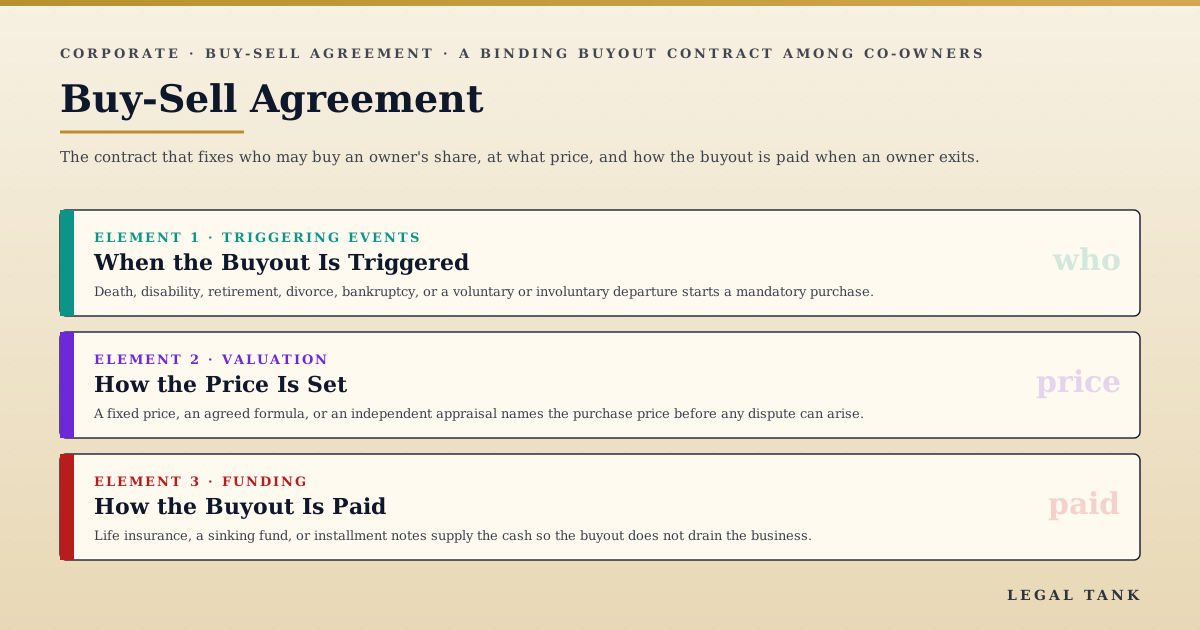
Trigger · Price · Funding
Three questions the agreement answers in advance
What Is a Buy-Sell Agreement and Why Every Co-Owned Business Needs One
A buy-sell agreement, sometimes written as a buy sell agreement, exists to answer one question before it becomes a crisis: what happens to an owner's share of the business when that owner leaves. It is a binding contract among the co-owners, and often the business entity itself, that fixes who may buy a departing owner's interest, at what price, and how the purchase is paid. Because the terms are settled while everyone is still on good terms, no one has to negotiate a buyout in the middle of a death, a divorce, or a falling-out.
Without a buy-sell agreement, the default outcomes are rarely what the owners would have chosen. A deceased owner's interest can pass to heirs who have no role in the business and no interest in running it. A divorcing owner's stake can be pulled into a marital settlement and end up partly owned by a former spouse. A departing owner can sell to a competitor or an outsider the remaining owners never approved. Each of these is a live risk the moment a business has more than one owner, and each is exactly what the agreement is built to prevent.
The document is transactional, not litigation. It is drafted by an attorney and executed by the owners, who sign it and keep it with the company records; it is never filed in court. Its force comes from careful drafting and proper signature, which is why a buy-sell agreement sits alongside the shareholder agreement as one of the foundational contracts a closely held business executes.
Cross-Purchase vs Entity-Purchase (Redemption) Buy-Sell Agreements
The first structural choice is who does the buying. In a cross-purchase, the remaining owners buy the departing owner's interest individually. In an entity-purchase, also called a redemption, the business itself buys the interest back. The choice drives the number of funding policies, the tax basis the buyers receive, and the administration as the owner count grows.
Cross-Purchase
Owners Buy From Each Other
The remaining owners individually purchase the departing owner's interest. Each owner is a buyer and typically holds a funding policy on every other owner. The buyers get a stepped-up cost basis in the interest they acquire, which lowers their capital gains tax on a later sale.
Best fit: two to a few owners
Entity-Purchase / Redemption
The Business Buys Back the Share
The company itself redeems the departing owner's interest, so the surviving owners' percentages simply rise. The business holds one funding policy on each owner. Administratively simpler as the owner count grows, but the survivors receive no basis step-up.
Best fit: several owners
Wait-and-See / Hybrid
Decide at the Trigger
The agreement gives the company the first option to redeem, then the owners the option to cross-purchase, and requires whichever party is best positioned to complete the buyout. It preserves flexibility on tax and funding until the triggering event actually happens.
Best fit: uncertain or changing ownership
The transfer restrictions and right of first refusal that make any of these structures work are the same mechanics a partnership agreement uses to keep a partnership interest from passing to an outsider.
Buy-Sell Agreement Triggering Events: Death, Disability, Retirement, Divorce, and Departure
A triggering event is what starts a buyout under the agreement. The death, disability, and retirement triggers are the ones most people expect, but a complete agreement also reaches divorce, bankruptcy, and both voluntary and involuntary departures, so an interest cannot slip to a former spouse, a bankruptcy trustee, or an outsider. Each trigger can be mandatory or optional and can carry its own price and payment terms.
- Death of an owner, usually a mandatory buyout funded by life insurance
- Permanent disability that prevents an owner from working in the business
- Retirement or reaching an agreed exit age
- Voluntary departure or resignation of an owner-employee
- Involuntary termination of an owner-employee for cause
- Personal bankruptcy or insolvency of an owner
- Divorce, so an interest cannot pass to a former spouse in a settlement
- Attempted transfer to an outside party, triggering a right of first refusal
- Loss of a professional license required to hold the interest
- Material breach of the owners' agreement
The distinction between a mandatory and an optional trigger matters. A death or disability buyout is usually mandatory and funded by insurance, because the estate needs liquidity and the business needs certainty. A voluntary departure is often handled through a right of first refusal at a formula price with installment payments, which gives the remaining owners control without forcing an immediate cash outlay.
Valuation Methods for a Buy-Sell Agreement: Fixed Price, Formula, and Appraisal
A buy-sell agreement is only as strong as the valuation method that sets the price when a trigger fires. An agreement that merely promises fair value invites a fight, so a well-drafted agreement names the exact method used to price the interest on a departure, and states how and when the number is refreshed.
Fixed or agreed value
The owners state a set price per unit of ownership and revisit it on a stated schedule, usually annually, by signing a certificate of agreed value. Simple and predictable, provided the owners actually refresh the number rather than letting it grow stale.
Formula value
The interest is priced by a stated calculation, such as a multiple of earnings before interest, taxes, depreciation, and amortization, a multiple of revenue, or adjusted book value. Predictable and inexpensive to administer, and it tracks the business as it grows.
Independent appraisal
A qualified business appraiser determines fair market value as of the trigger date. The agreement names how the appraiser is chosen and how competing appraisals are reconciled, which removes bias between the departing owner and the buyers.
Combined or default method
Many agreements use the agreed value if it was updated within the last year and fall back to an appraisal if it was not. Combining methods guards against a stale fixed price without giving up the certainty of an agreed number.
The most common failure in practice is a fixed value that no one updated. An agreed price set years ago, before the business doubled in size, can force a departing owner or a deceased owner's estate to accept a fraction of true value, or hand the buyers a windfall. That is why the agreement should require the owners to sign a fresh certificate of agreed value on a set schedule, and default to an appraisal if they let the number go stale.
Funding a Buy-Sell Agreement With Life Insurance
A buyout is only real if the cash is there to complete it. Life insurance is the most common way to fund the death trigger in a life insurance buy-sell agreement, because the proceeds arrive as tax-free cash exactly when the buyout is due, without draining the company's working capital or forcing the survivors to borrow. Who owns the policies follows the structure: in a cross-purchase each owner insures every other owner, and in an entity-purchase the company insures each owner.
A worked example shows how the policy count differs. Take three equal owners of a business worth 3,000,000 dollars, so each interest is worth 1,000,000 dollars. Under a cross-purchase, when one owner dies the two survivors each buy half of the deceased owner's interest for 500,000 dollars, so every owner carries a 500,000 dollar policy on each of the other two. That is six policies of 500,000 dollars in total. Under an entity-purchase, the company instead holds three policies of 1,000,000 dollars, one on each owner, and redeems the full interest itself. Same 3,000,000 dollars of total coverage, arranged two different ways.
Death is not the only trigger that needs funding. Disability buyouts are funded with disability buyout insurance or with installment notes, since the departing owner is alive to be paid over time. Retirement and voluntary departures are commonly funded through installment payments or a sinking fund, spreading the cost over several years so the business can absorb it. The funding is always sized to the valuation, so the money available matches the price the agreement sets.
Buy-Sell Agreement for a Small Business: LLC, Corporation, and Partnership
Any small business with more than one owner benefits from a buy-sell agreement, and the document adapts to the entity type. What it restricts, and which companion document it coordinates with, changes depending on whether the owners hold shares, membership interests, or partnership interests.
Corporation
The buy-sell agreement governs the transfer of shares, sets the transfer restrictions and right of first refusal, and coordinates with the shareholder agreement. Share certificates carry a legend noting the restriction so a buyer is on notice.
LLC
The buy-sell provisions restrict the transfer of membership interests and are often built directly into the operating agreement or executed as a companion document, so a member cannot hand an interest to an outsider without the others' consent.
Partnership
The agreement controls the transfer of partnership interests and coordinates with the partnership agreement. This matters because the departure of a partner can otherwise dissolve the partnership by operation of law absent a continuation provision.
For a multi-member company, the transfer restrictions are frequently built straight into the LLC operating agreement, so the buy-sell terms and the governance terms live in one place. Where the plan is instead to sell the whole company to an outside buyer rather than among the owners, the deal runs through a share purchase agreement instead.
How to Set Up a Buy-Sell Agreement
Six steps take a buy-sell agreement from a roster of owners to a funded, priced, and signed contract. The owners and the triggering events are settled first, because they decide the structure, the valuation, and the funding that follow.
- 1
Inventory the owners and the exit events
List every current owner and the interest each holds, then decide which events trigger a buyout: death, disability, retirement, divorce, bankruptcy, and voluntary or involuntary departure. This is fixed first because it defines everything downstream.
- 2
Choose the structure
Decide between a cross-purchase, an entity-purchase (redemption), or a wait-and-see hybrid. The choice turns on the number of owners and the tax basis consequences, so it is settled before pricing and funding.
- 3
Fix the valuation method
Name a fixed or agreed value, a formula, an independent appraisal, or a combination, and state how and when the price is refreshed. The method is chosen now so the price is never negotiated under the pressure of a trigger.
- 4
Arrange the funding
Match each trigger to a funding source: life insurance for death, disability buyout coverage for disability, and installment notes or a sinking fund for retirement and departure. Funding is sized to the valuation so the cash is there when the buyout is due.
- 5
Draft and execute the agreement
The instrument names the parties, the triggers, the structure, the price mechanism, the funding, the payment terms, a joinder for new owners, and a certificate legend. Every current owner signs, because the agreement binds only those who execute it.
- 6
Review on a set schedule
The owners revisit the agreed value, the funding amounts, and the ownership roster at least annually and whenever an owner joins or leaves. A stale value or an underfunded policy is where a buy-sell agreement fails in practice.
Part of the corporate stack: the shareholder agreement that governs voting and share transfers, the partnership agreement for unincorporated ventures, and the LLC operating agreement that houses the buy-sell terms for a multi-member company.
Buy-Sell Agreement: Common Questions
What is a buy-sell agreement?
What is the difference between a cross-purchase and an entity-purchase buy-sell agreement?
What events trigger a buy-sell agreement?
How is the price set in a buy-sell agreement?
How does life insurance fund a buy-sell agreement?
Does an LLC, corporation, or partnership need a buy-sell agreement?
Is a buy-sell agreement legally binding?
Settle the Buyout Before You Need It
Tell us who the owners are, your entity type, and which exit events you want covered. We return the right structure, a valuation clause, and a funding plan, drafted to your state law for the owners to sign.
Quotes return same business day on intakes received before 5 PM ET