What Is a Summons? Service, Response Deadline, and Default Risk
Direct Answer
A summons is the official court paper that notifies a defendant a lawsuit has been filed and starts the response clock. In federal civil practice, the summons is governed by Federal Rule of Civil Procedure 4, served together with the complaint, and requires an answer or motion within twenty-one days under FRCP 12(a)(1)(A)(i). The Supreme Court in Mullane v. Central Hanover Bank and Trust Co. held that service must be reasonably calculated to apprise the defendant of the action, which is why service rules are strict and defective service is challengeable. Ignoring the summons exposes the defendant to default judgment under Rule 55.
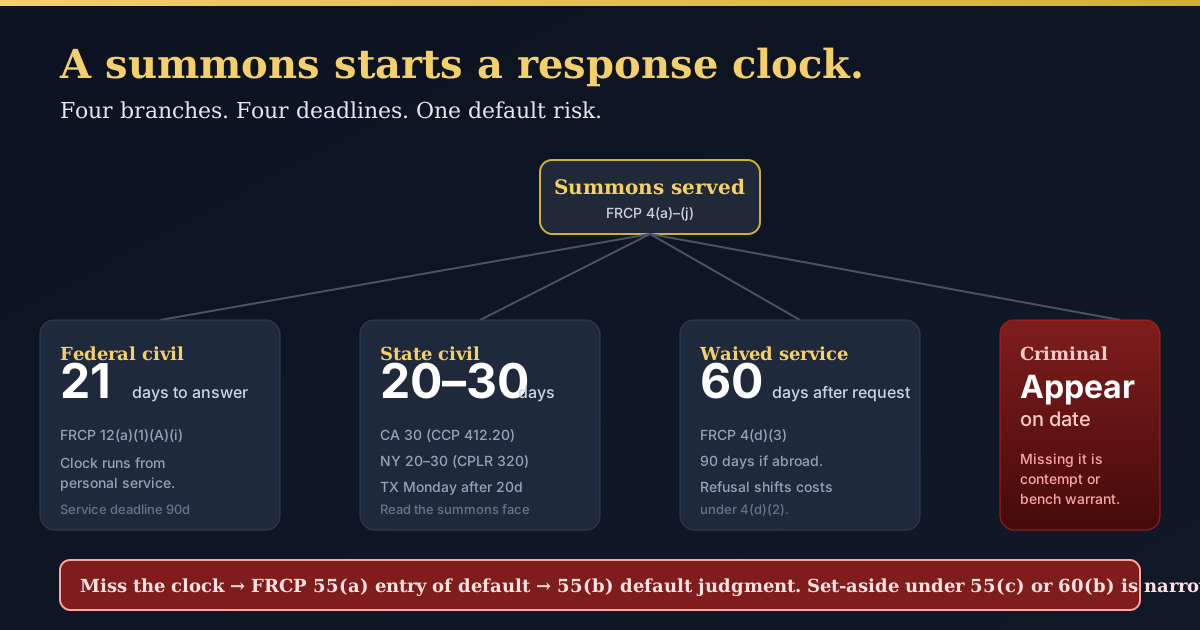
FRCP 12(a)(1)(A)(i)
Twenty-one days from service. Miss the clock and the plaintiff can ask the clerk to enter default.
FRCP 12(a)(1)(A)(i)
21 days from service
File answer or Rule 12 motion
State CCP or CPLR
20 to 30 days, varies by state
File answer or demurrer
FRCP 4(d)(3)
60 days from waiver request
File answer (60-day extension)
FRCrP 4 (federal) or state rules
Appear on date stated
In-person appearance at arraignment
Anatomy of a Summons: The Six Required Contents Under FRCP 4(a)
Before answering on the merits, a served defendant should verify that the summons is facially valid. Federal Rule of Civil Procedure 4(a)(1) enumerates six items that every issued summons must contain. A defective summons supports a pre-answer motion under FRCP 12(b)(4) (insufficient process) or 12(b)(5) (insufficient service of process), and either motion can be raised in the answer window without forfeiting other defenses.
Court name and case caption
The summons must identify the issuing court (which establishes the forum) and carry the case caption with all named parties. A summons that omits the court is facially defective under Federal Rule 4(a)(1)(A).
Docket number
Every issued summons carries a case or docket number assigned when the complaint was filed with the clerk. This number is what the court uses to track all filings, and a defendant should write it on every responsive paper.
Defendant identification and service address
The defendant's name and the address used for service appear on the face of the summons. Defective service at the wrong address is a classic ground for a Rule 12(b)(5) motion to dismiss for insufficient service of process.
Time to appear or answer
The summons states the response deadline, ordinarily twenty-one days in federal civil practice under FRCP 12(a)(1)(A)(i), or sixty days when service was waived under FRCP 4(d)(3). State court summonses state the analogous state deadline.
Consequence of failure to respond
Under FRCP 4(a)(1)(D), the summons must warn the defendant that failure to appear and defend will result in default judgment. A summons that omits this warning is procedurally suspect.
Clerk's signature and court seal
FRCP 4(a)(1)(F) and 4(b) require the issued summons to be signed by the clerk and bear the court's seal. An unsigned or unsealed summons is not properly issued and cannot be served effectively.
Civil vs Criminal vs Administrative
The civil summons described here is the dominant federal and state variant. A criminal summons is an order to appear in court on a stated date for arraignment, used in lieu of arrest for minor offenses under Federal Rule of Criminal Procedure 4 and state analogues. An administrative summons is issued by an agency (most commonly the IRS under Internal Revenue Code section 7602) demanding records or testimony. All three derive their authority from the same due-process principle in Mullane v. Central Hanover Bank and Trust Co. that notice must be reasonably calculated to inform the recipient.
How Service of Process Works: FRCP 4(c) Through 4(j)
Once the summons is issued, the plaintiff is responsible for getting it (and the complaint) into the defendant's hands. The method of service depends on who the defendant is and where they are. The Supreme Court established the constitutional floor in Mullane v. Central Hanover Bank and Trust Co., 339 U.S. 306 (1950): notice must be reasonably calculated, under all the circumstances, to apprise interested parties of the pendency of the action. Federal Rule 4 implements that floor with the menu below.
Plaintiff serves, not the court
FRCP 4(c)(1)
Service of the summons and complaint is the plaintiff's responsibility, not the court's. The plaintiff (or a process server, or the U.S. Marshal where the court so orders) must complete service within the time set by Rule 4(m).
Waiver of service by mail
FRCP 4(d)
The plaintiff may request that the defendant waive formal service. A defendant who returns a signed waiver gets sixty days to answer instead of twenty-one. A defendant who refuses without good cause can be ordered to pay the cost of formal service.
Personal or abode service on an individual
FRCP 4(e)
An individual within the United States may be served by personal delivery, by leaving copies at the defendant's dwelling with a person of suitable age and discretion residing there, or by delivery to an authorized agent. State-law service methods are also permitted under Rule 4(e)(1).
Service on a corporation, partnership, or association
FRCP 4(h)
An entity is served by delivering the summons and complaint to an officer, a managing or general agent, or any other agent authorized by appointment or by law to receive service of process. Registered-agent services exist precisely to standardize this delivery point.
Service on the United States or a state
FRCP 4(i), 4(j)
Service on the United States requires delivery to the U.S. Attorney for the district and the Attorney General; service on a state, municipality, or other governmental organization is made under state law or by delivery to the chief executive officer.
Foreign defendants and the Hague Convention
FRCP 4(f); Hague Service Convention
Service abroad is made by any internationally agreed means, including those authorized by the Hague Service Convention. The Supreme Court held in Volkswagenwerk Aktiengesellschaft v. Schlunk that the Hague Convention does not preempt valid domestic service on a foreign defendant's authorized agent inside the United States.
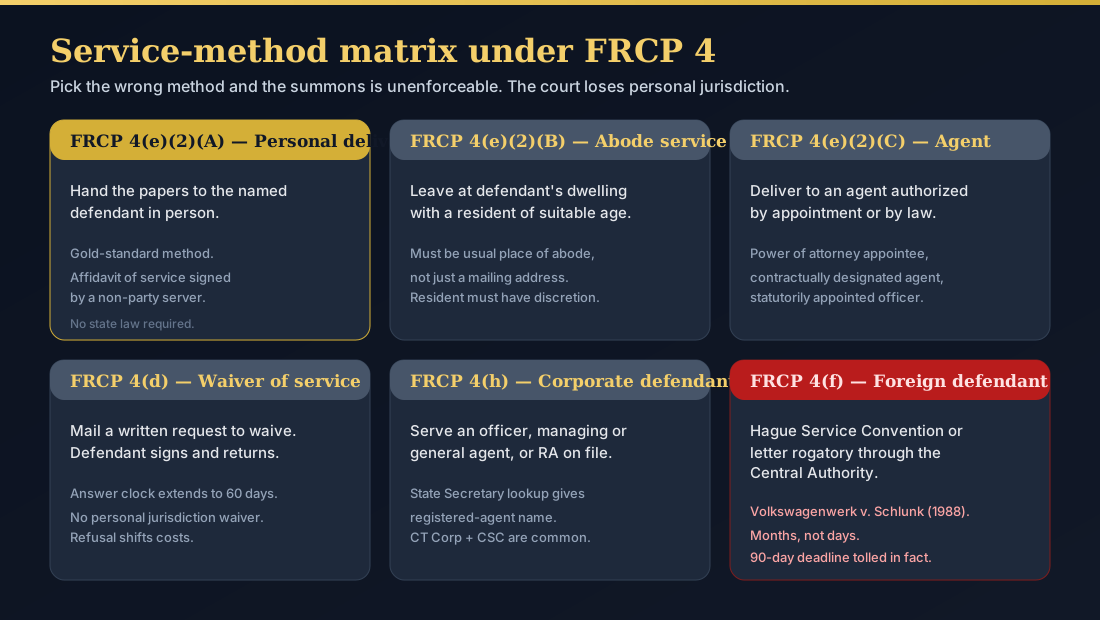
The full federal service menu under FRCP 4. Statutory text is available at Cornell LII FRCP Rule 4.
The Response Clock: Federal Default and State Analogues
The most expensive variable on a summons is the response deadline. Federal civil cases run on a twenty-one-day clock from service under FRCP 12(a)(1)(A)(i); state cases run on their own statutes. A waived-service stipulation under FRCP 4(d)(3) trades a small concession for a much longer answer window, which is why many commercial defendants accept the waiver. The table below covers the federal default plus the three largest state-court jurisdictions.
| Forum | Deadline | Rule |
|---|---|---|
| Federal civil (ordinary service) | 21 days from service | FRCP 12(a)(1)(A)(i)The federal answer or pre-answer motion is due within twenty-one days of personal service on the defendant. |
| Federal civil (waived service) | 60 days from request | FRCP 4(d)(3)If the defendant signs and returns the waiver, the answer is due sixty days after the plaintiff sent the waiver request (ninety days if the defendant is outside the United States). |
| Federal civil (United States as defendant) | 60 days from service | FRCP 12(a)(2)When the United States, a federal agency, or a federal officer is the defendant, the answer is due within sixty days of service. |
| California state civil | 30 days from service | CCP section 412.20(a)(3)The California Code of Civil Procedure gives the defendant thirty days from service of the summons to file a responsive pleading. |
| New York state civil | 20 days (personal) or 30 days (other) | CPLR 320(a)Twenty days if the defendant was served by personal delivery within New York; thirty days if served by other authorized methods or outside the state. |
| Texas state civil | First Monday after 20 days | TRCP 99(b)The Texas Rules of Civil Procedure require the defendant to answer by 10:00 a.m. on the Monday next following the expiration of twenty days after the date of service. |
| Federal service deadline | 90 days from filing | FRCP 4(m)If the plaintiff has not served the defendant within ninety days after the complaint is filed, the court must dismiss without prejudice or order service within a specified time. Good cause extends the deadline. |
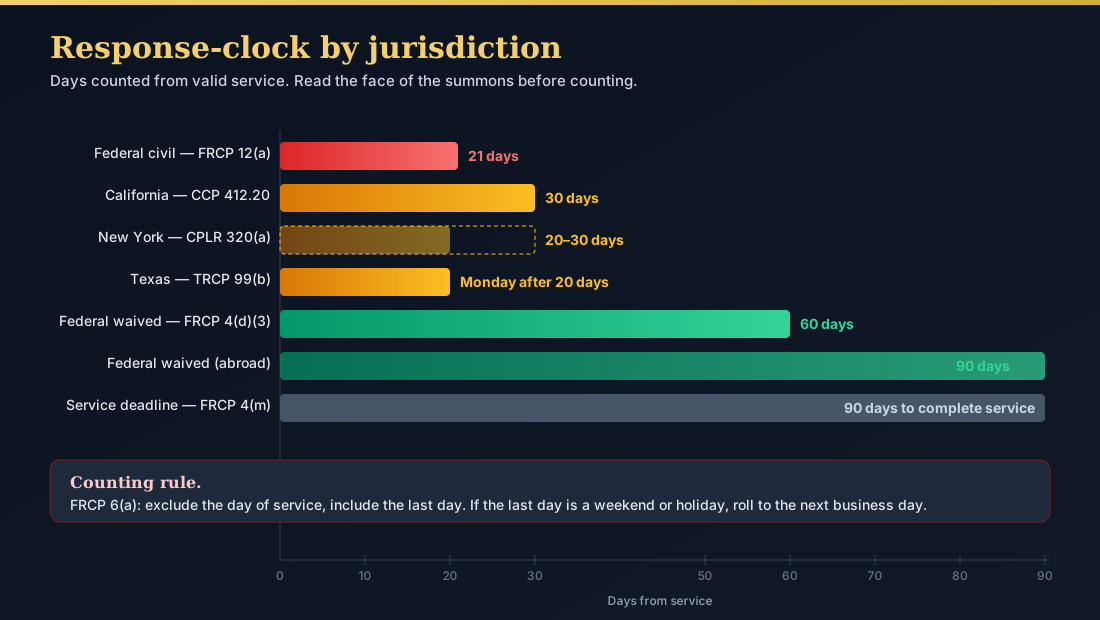
Cross-jurisdictional comparison of civil response deadlines. The federal twenty-one-day clock and the state analogues all derive from the same Mullane due-process floor; the precise count varies by sovereign. Federal text at Cornell LII FRCP Rule 12.
Plaintiff-side: FRCP 4(m)
The plaintiff has its own clock. Under FRCP 4(m), the plaintiff must serve the summons and complaint within ninety days after the complaint is filed. If service is not made within that window, the court must dismiss the action without prejudice or order that service be made within a specified time. Good cause extends the deadline. Defendants reviewing the proof of service on the docket should check the gap between the file date and the service date for any Rule 4(m) defect.
What to Do If You Were Served: A Six-Step Playbook
The window between service and answer is short and consequential. The six steps below are the standard sequence civil defense counsel runs from the day a client calls in with a summons in hand. Working through them in order preserves every Rule 12 defense and anchors the response calendar.
Confirm what was served and when
Photograph or scan the summons, the complaint, and any process-server affidavit on the day you receive them. Note the exact time and place of service, the name of the person who served you, and whether anything was left at a residence rather than handed to you personally. These facts feed any later challenge under Rule 12(b)(5).
Calendar the deadline that day
Find the response period stated on the face of the summons. Federal civil cases ordinarily run on a twenty-one-day clock under FRCP 12(a)(1)(A)(i); state-court cases run on the state analogue. Add the deadline to two calendars (personal plus counsel's docket) and set a hard reminder one week before.
Identify the court and read the complaint
The court name and case number appear on the summons. Read the entire complaint at least once to understand the claims, the demand for relief, and any jurisdictional allegations. Note the plaintiff's counsel of record because all later filings are served on them.
Decide on counsel or pro-se representation
Most defendants benefit from counsel, especially in federal practice where Twombly and Iqbal pleading challenges, removal jurisdiction questions, and protective-order practice all happen in the answer window. If the matter is a debt-collection action with a clear defense (statute of limitations, identity error, prior payment), pro-se filing is feasible. Route the matter through /get-quote if you are unsure.
File the answer or a Rule 12 motion before the deadline
The defendant may answer the complaint paragraph by paragraph, assert affirmative defenses under FRCP 8(c), and counterclaim if a claim against the plaintiff exists. Alternatively, the defendant may file a pre-answer Rule 12 motion, which tolls the answer clock under FRCP 12(a)(4). Common pre-answer motions are 12(b)(2) (personal jurisdiction), 12(b)(5) (insufficient service), and 12(b)(6) (failure to state a claim).
Preserve the service documents permanently
The original summons, the complaint, and the certificate or affidavit of service are part of the case record forever. Keep them in a labeled folder (digital and paper) for the life of the matter plus any appeal period. They will be needed if the parties later dispute when the answer was due or whether service was proper.
When the underlying claim is a money dispute
Many civil summonses arise from unpaid invoices, breach-of-contract claims, or pre-suit demand letters that were ignored. If the dispute is on the defense side, the matter typically routes through a breach-of-contract attorney; if the defendant is the party owed money and the summons reflects a counter-filing, the original demand path may need to be re-papered. Either way, the answer window is the wrong time to negotiate; pre-answer settlement discussions should run in parallel with a filed breach-of-contract defense.
Default Judgment Risk: From Missed Deadline to Enforcement
The cost of ignoring a summons is not the lawsuit; it is the default judgment that follows when the answer clock runs out. Federal Rule 55 maps the chain in two stages: clerk entry of default under FRCP 55(a), then court entry of default judgment under FRCP 55(b). Once judgment is final, the plaintiff has access to the ordinary enforcement toolkit (bank levy, wage garnishment, abstract recordings, credit reporting). Set-aside is available under FRCP 55(c) before final judgment and under FRCP 60(b) after, but each step of delay narrows the path.
Missed deadline
The defendant fails to answer or file a Rule 12 motion within the response window stated on the summons. Under FRCP 12(a)(1)(A)(i), the federal default window is twenty-one days.
Clerk entry of default
The plaintiff applies to the clerk under FRCP 55(a) for entry of default. The clerk reviews the proof of service and the absence of any responsive pleading, then enters default on the docket. No notice to the defendant is required at this point.
Motion for default judgment
The plaintiff then moves for default judgment under FRCP 55(b). For a sum certain, the clerk can enter the judgment under Rule 55(b)(1); for unliquidated damages, the court holds an inquest under Rule 55(b)(2) before entering judgment. Notice to the defendant is required only if the defendant has appeared.
Enforcement
Once judgment is entered, the plaintiff can record an abstract of judgment, levy on bank accounts, garnish wages where state law permits, and report the judgment to credit bureaus. The clock for these enforcement steps starts running as soon as the judgment is final.
Set-aside under FRCP 55(c) or 60(b)
Before final judgment, the defendant can move under FRCP 55(c) to set aside the entry of default for good cause. After final judgment, the higher Rule 60(b) standard applies (mistake, excusable neglect, fraud, or other extraordinary circumstance). The motion should be filed as early as possible because delay weighs against the defendant.
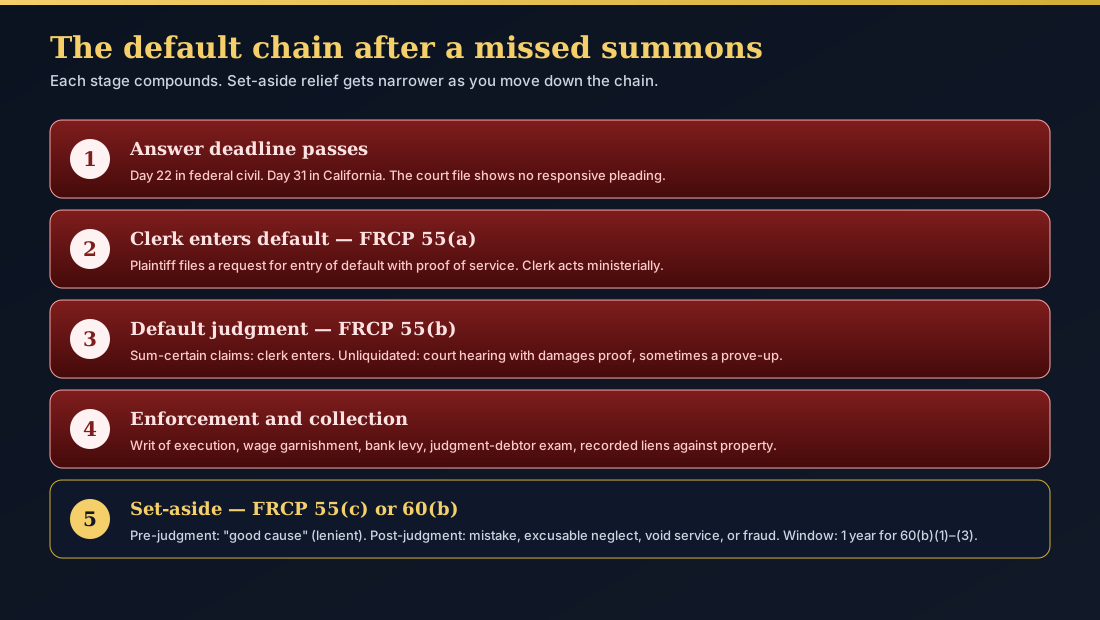
The five-stage default chain. Every additional day past the answer deadline pushes the matter further down the chain and increases the difficulty of the set-aside motion.
Set-aside in practice
The federal courts apply a three-factor test on a Rule 55(c) motion: whether the defendant acted with culpable conduct in defaulting, whether a meritorious defense is presented, and whether the plaintiff is prejudiced by setting aside the default. Federal courts apply the test more liberally before final judgment than under Rule 60(b) afterward. The motion should attach a proposed answer so the court can evaluate the meritorious-defense factor concretely. For defendants in this posture, the path forward is a coordinated motion plus answer drafted in one sitting; a drafted demand letter can also pre-test settlement before the motion is filed.
Frequently Asked Questions About Summons
Questions sourced from Google's People Also Ask panel; answers pivoted toward defendant-side comprehension and the federal civil-procedure framework.
Can you ignore a summons?
What are the two types of summons?
What does it mean if someone gets a summons?
How to write a summons letter?
Should I be worried about a summons?
What does it mean when someone summons you?
Served with a Summons? Move Before the Clock Runs.
Federal civil defendants have twenty-one days under FRCP 12(a)(1)(A)(i) to file an answer or a Rule 12 motion. State deadlines range from twenty to thirty days. The day you were served is day one; do not let the deadline run before the matter is in the hands of counsel.