Subpoena: What It Is, How to Respond, and When You Can Challenge One
A subpoena is a written court command that requires a named person or entity to produce documents, give testimony, or both. The instrument carries the issuing court's contempt power, which is what distinguishes a subpoena from a voluntary request for information. In federal civil practice the controlling rule is FRCP Rule 45, which sets out the three subpoena types, the service mechanics, the geographic reach, the recipient's response options, and the grounds on which a court will quash or modify a defective subpoena. State courts run their own analog rules, and federal agencies issue administrative subpoenas under separate statutory authority. This pillar walks through the doctrine, the three subpoena types, the four response branches every recipient faces, and the seven-step response playbook from service through production.
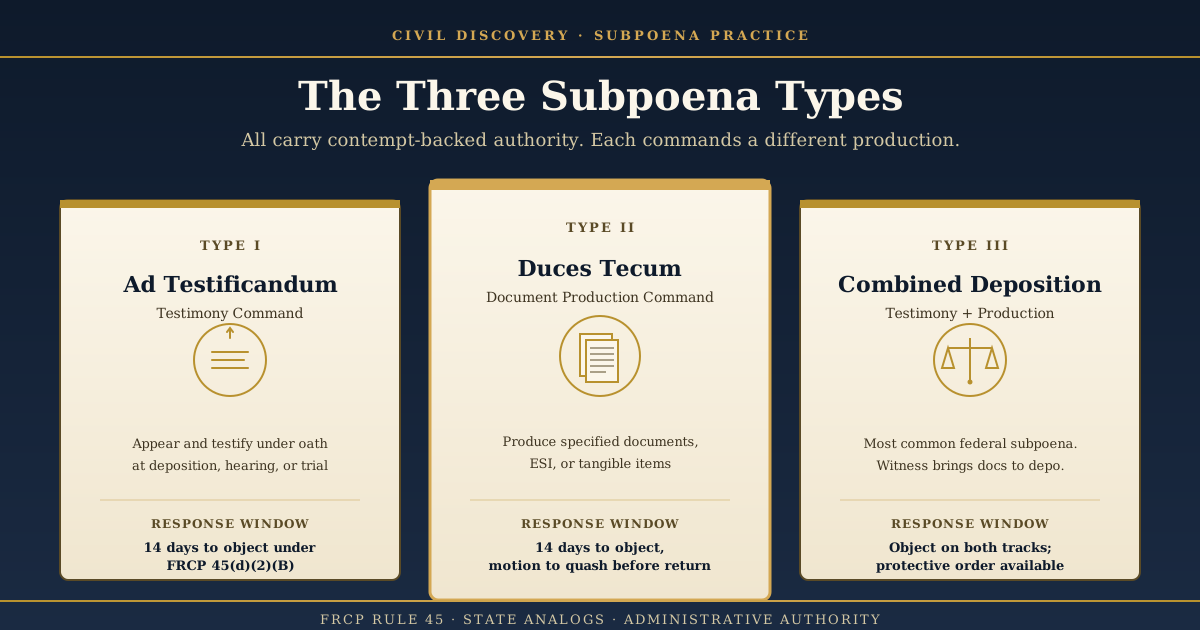
How a Subpoena Reaches You: Federal Rule 45, State Analogs, and the Three Subpoena Types
A subpoena can reach you from three separate authority tracks, and the track matters because each one runs on a different rulebook, a different deadline calendar, and a different enforcement court. The first track is federal civil litigation under FRCP Rule 45: a party to a federal case issues a subpoena to a non-party witness or records custodian, and compliance disputes are heard by the federal court for the district where compliance is required. The second track is state civil litigation: each state has its own analog rule (California Code of Civil Procedure section 1985 and following, Texas Rule of Civil Procedure 176, New York CPLR 2301 and 2305, Illinois Supreme Court Rule 204, Florida Rule 1.410, and so on), with separate service mechanics and separate filing deadlines for any motion to quash. The third track is administrative or grand jury: agencies including the SEC, OSHA, EEOC, IRS, FTC, and DOJ issue investigative subpoenas under their own organic statutes, and a grand jury subpoena issued under FRCRP 17 carries criminal-process authority.
Federal AO 88, AO 88A, and AO 88B: The Federal Subpoena Forms
The federal court system uses three standardized forms for civil subpoenas. The federal subpoena form AO 88 is the general civil subpoena to appear and testify at a hearing or trial. AO 88A is the deposition subpoena commanding testimony and (optionally) document production at a deposition. AO 88B is the production-only subpoena commanding documents or inspection of premises without testimony. The forms are published by the Administrative Office of the United States Courts and used in every federal district. The face of the form sets out the issuing court, the case caption, the witness name, the date and time of production or appearance, and the geographic reach limitation under Rule 45(c) (a subpoena cannot command attendance more than 100 miles from the recipient's residence, regular place of business, or place of employment, except for trial within the state). The reverse side of each form prints the recipient's rights, the objection procedure, and the contempt warning.
Who Has the Power to Issue One
Two categories of persons can issue a federal civil subpoena. The court clerk can issue a subpoena signed but otherwise blank, which the requesting attorney then completes. More commonly, any attorney authorized to practice in the issuing court may issue a subpoena as an officer of the court under FRCP 45(a)(3); the attorney's signature on the face of the form is the issuing authority. State practice is similar: state-court attorneys generally have parallel authority to issue under their state rules. The administrative track is different: agency subpoenas are issued by the agency or its designated investigator under statutory authority, and grand jury subpoenas are issued by the grand jury foreperson with the United States Attorney's office as the procedural conduit. The fact that an attorney (not a judge) signed the subpoena does not weaken the contempt enforcement authority; the rule expressly delegates issuance to officers of the court.
The Three Subpoena Types
Subpoena Ad Testificandum
Commands the recipient to appear at a deposition, hearing, or trial and give testimony under oath. The schedule lists time, place, and (for depositions) the parties present and the recording method. The witness is not required to bring documents unless the same instrument is paired with a duces tecum command.
Subpoena Duces Tecum
Commands the production of specified documents, electronically stored information, or tangible items. The schedule (often Schedule A) lists each document category with date ranges, custodians, and format. Production can be in person on the return date or, more commonly in federal practice, on a rolling basis to a designated counsel address.
Combined Deposition Subpoena
Pairs ad testificandum with duces tecum: the witness appears and testifies under oath, and produces the listed documents at or before the deposition. This is the most common federal subpoena form in commercial litigation because it lets the issuing party question the witness about the same documents the schedule commands.
Reading a Subpoena: Caption, Command, Return Date, and Service
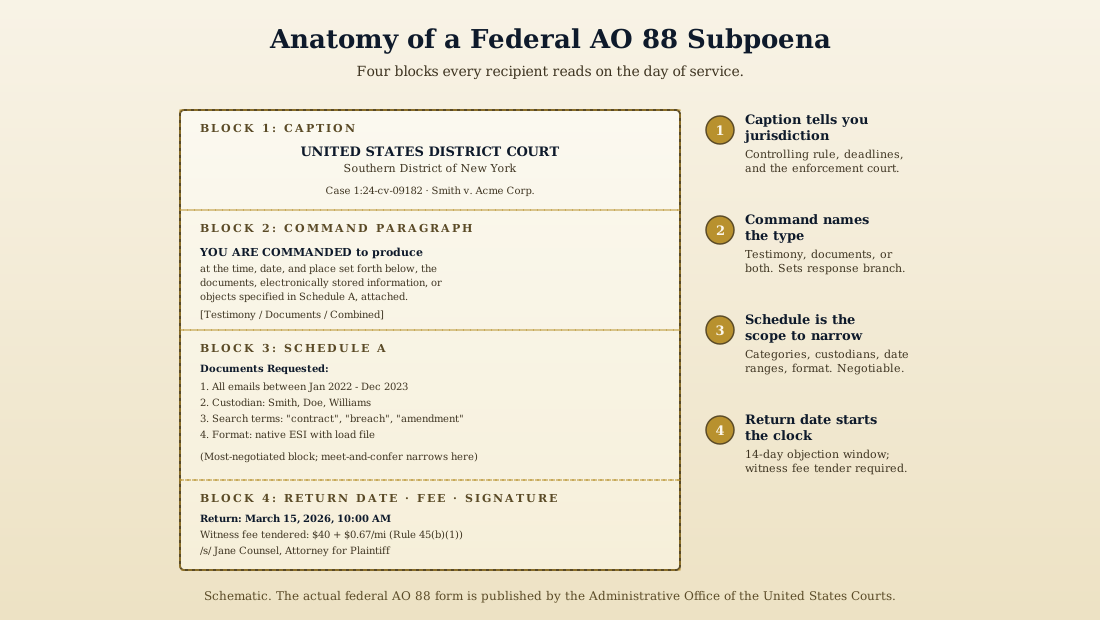
Reading a served subpoena means working through four anatomical blocks in order. The first block is the caption, which identifies the issuing court, the case number, the parties to the underlying action, and the witness or custodian being commanded. The caption tells you the controlling jurisdiction: "United States District Court for the Southern District of New York" is governed by federal Rule 45 and the local rules of the S.D.N.Y., while "Superior Court of California, County of Los Angeles" runs on California Code of Civil Procedure 1985 and following. The second block is the command paragraph itself, which states whether the recipient must testify, must produce documents, or both. The command paragraph identifies the date, time, and place of compliance, and the form of production (testimony under oath, paper documents, electronically stored information, or a deposition recording).
The Schedule and the Scope of Production
The third block is the schedule. For a subpoena duces tecum, the schedule is typically labelled "Schedule A" and lists each document category with a date range, the custodians or systems to be searched, and the format of production. A well-drafted schedule names categories with enough specificity that the recipient can run a targeted search, but many subpoenas served on third parties are overbroad on initial issuance and get narrowed through meet-and-confer correspondence before any production runs. For a subpoena ad testificandum, the schedule typically identifies the deposition or hearing topic, the parties present, and the recording method (stenographic, videotaped, or remote). For a combined deposition subpoena, the schedule does both. The schedule is the most negotiable part of any subpoena, and the response playbook below treats schedule narrowing as one of the primary tools the recipient has.
Return Date, Compliance Window, and Witness Fees
The fourth block is the return date and the witness-fee tender. Under FRCP 45(b)(1), a subpoena commanding attendance must be served together with the fees for one day's attendance and the mileage allowed by law (computed under the federal per-mile rate), and a subpoena commanding production only does not require a witness fee tender. Failure to tender the witness fee where one is required can render the subpoena unenforceable. The return date itself sets the compliance deadline, and the gap between service and return date is what the recipient evaluates against the "reasonable time to comply" standard under Rule 45(d)(3)(A)(i). A return date inside ten business days for a multi-thousand-document demand routinely fails this prong, and is one of the most common quash grounds.
Why Proper Service Matters
Service of a federal subpoena under FRCP 45(b)requires personal delivery to the named recipient (or, in many districts under local rule, service on counsel of record where the recipient is represented). Service by mail alone is generally insufficient for a federal civil subpoena, and service by email is permitted only where the recipient has agreed in writing or where the rule expressly authorizes it. State practice varies widely: California permits personal service for most subpoenas under CCP 1985.3 with separate consumer-notice rules, while New York under CPLR 2303 allows several methods including service on a designated agent. A subpoena that was not properly served is not enforceable; the recipient can raise the service defect as a ground for the court to refuse contempt and as a ground for any motion to quash. For the procedural device that asks the court to set aside a defective subpoena, the pillar on what a motion to quash is and the grounds courts accept to set aside a subpoena walks through the full doctrine and the five recognized prongs that get a subpoena set aside.
Your Response Options: Comply, Object, Negotiate, or Move to Quash
Every recipient of a subpoena stands at a four-branch decision tree once the instrument has been served. The four branches are not strict alternatives; in practice they run in parallel and overlap. A recipient who plans to comply on most categories can still object on a few overbroad categories. A recipient who is negotiating scope with the issuing party can still preserve the right to move to quash if conferral does not close the gap by the compliance date. The mistake the rule recognizes and sanctions is doing none of the four: silence in the face of a validly served subpoena exposes the recipient to contempt under FRCP 45(g) and the state-court analog.
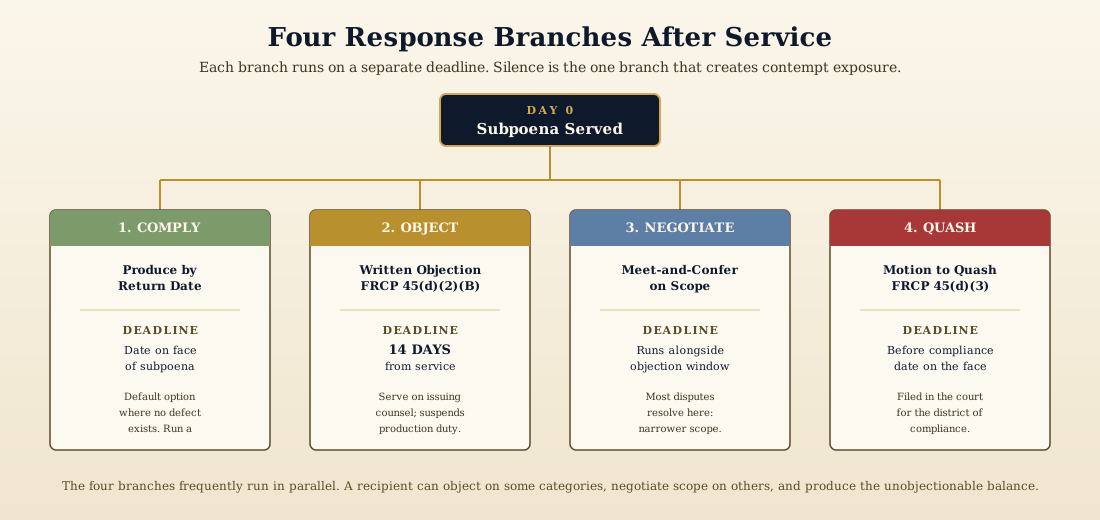
Comply by the Return Date
Default option if no defect exists
Read the schedule, gather the responsive material, log any privileged documents on a Rule 26(b)(5) privilege log, and produce on or before the return date. Most non-party subpoenas resolve here without dispute. The cost of compliance, where excessive, can sometimes be shifted to the issuing party under Rule 45(d)(2)(B)(ii).
Written Objection Under FRCP 45(d)(2)(B)
Must be served within 14 days of subpoena service or before compliance date, whichever is earlier
Serve a written objection on the issuing attorney identifying each specific objection (overbreadth, undue burden, privilege, proportionality). Once served, the subpoenaed party is not required to comply with the objected-to portion unless and until the issuing party obtains a court order compelling compliance.
Negotiate Scope via Meet-and-Confer
In parallel with the objection deadline
Most subpoena disputes resolve through written correspondence and a meet-and-confer call: shorter time periods, fewer custodians, narrower document categories, agreed cost allocation, agreed protective order. The federal civil rules favor proportionality, and a reasonable counter-proposal is often accepted in writing before any motion practice is needed.
Motion to Quash or Modify
File before compliance date, in the court for the district where compliance is required
If objection and meet-and-confer do not resolve the dispute, the recipient files a motion to quash or modify the subpoena under FRCP 45(d)(3). The motion identifies the prong (insufficient time, 100-mile geographic reach, privileged matter, undue burden, trade secret, unretained expert) and asks the court for an order quashing or narrowing the subpoena.
Coordinating With Other Discovery Motions
A subpoena dispute frequently arrives alongside other pretrial discovery filings. The issuing party, frustrated by a slow or partial production, may pair the subpoena with a motion to compel against the same recipient. The recipient's counter-move is usually the motion to quash combined with a motion for protective order. For the discovery-enforcement counter-vehicle the issuing side uses, the pillar on attorney-drafted motion to compel discovery briefs and FRCP 37 enforcement filings walks through the federal compulsion architecture. For the quashing counter-vehicle the recipient uses, the doctrinal explainer on the grounds courts accept to set aside a subpoena under FRCP 45(d)(3) covers the five recognized prongs and the proposed-order mechanics.
How to Respond Step by Step, From Service to Production
The seven-step playbook below runs from the day the subpoena arrives to the day production closes or the deposition concludes. Each step has a defined output (a calendar entry, a written objection, a conferral letter, a privilege log, a production cover letter) so the response file can be reconstructed if a dispute arises later. The same structure works for federal Rule 45 subpoenas, state-court subpoenas under the applicable analog rule, and most administrative subpoenas, with the controlling rule swapped in at step two.
- 01
Date-Stamp the Service Copy
Mark the date and method of service on the face of the subpoena (personal service, mail, agent service, electronic). The service date starts every downstream deadline: the fourteen-day objection window under Rule 45(d)(2)(B), the compliance date on the face of the subpoena, and any local-rule meet-and-confer timeline. Confirm the proof of service matches what actually happened, because defective service is itself a quash ground under FRCP 12(b)(5) analog principles.
- 02
Identify the Controlling Rule
Federal subpoenas run on FRCP 45. State subpoenas run on the state rule named in the caption: CCP 1985 in California, TRCP 176 in Texas, CPLR 2301 in New York, ORCP 55 in Oregon, and so on. Administrative subpoenas (SEC, OSHA, EEOC, IRS, FTC) and grand jury subpoenas run on agency-specific statutes and have different objection mechanics. The controlling rule determines the deadlines, the available defenses, and the court that hears any motion practice.
- 03
Calendar the Two Critical Deadlines
The compliance date is on the face of the subpoena (the return date). The objection deadline under Rule 45(d)(2)(B) is fourteen days from service or the compliance date, whichever is earlier. Both go on the calendar the same day the subpoena is logged. State practice varies: California requires a motion to quash a deposition subpoena duces tecum at least five days before production under CCP 1985.3, Texas requires the motion within a reasonable time before compliance under TRCP 176.6(e).
- 04
Scope the Response and the Privilege Exposure
Map each item in the schedule against the documents and testimony actually in your possession. Flag privileged material (attorney-client communications, work product, doctor-patient, trade-secret, Fifth Amendment exposure) and prepare a Rule 26(b)(5) privilege log if any responsive material is being withheld. Also flag any preservation obligation: once you know about the subpoena, spoliation exposure attaches, so suspend any document destruction policies on responsive material.
- 05
Confer With Issuing Counsel on Scope and Burden
Federal courts and most state courts expect a documented meet-and-confer before any motion to quash. The conferral letter quantifies the burden (custodian hours, document volume, vendor cost), proposes a narrower scope (shorter date range, fewer custodians, agreed search terms), and asks for an extension if the return date is unreasonably short. Many subpoena disputes resolve here in writing, and the conferral correspondence is the first exhibit on any subsequent motion if the dispute does not resolve.
- 06
Decide Among the Four Branches
Based on the deadline calendar and the conferral outcome, choose: comply by the return date, serve a written objection, continue negotiating with a documented extension, or move to quash or modify. The decision is rarely binary: a recipient can serve a Rule 45(d)(2)(B) objection on the burdensome categories while complying with the unobjectionable categories, or move to quash on a single prong while producing the rest. The right path depends on which categories of material are at issue and how reasonable the issuing party has been in conferral.
- 07
Produce or Appear by the Return Date
Produce on or before the return date in the format the schedule specifies (paper, native ESI, load file, or a different format if one was negotiated). Pair the production with a cover letter that itemizes what is produced, what is withheld on privilege grounds (cross-referenced to the privilege log), and any document categories where the production is ongoing. For testimonial subpoenas, appear at the noticed time and place, or move for a protective order if the deposition itself is improper.
When to Bring In Counsel
Most routine third-party document subpoenas can be handled by an in-house records custodian and a careful read of the schedule. Counsel becomes necessary when (1) the subpoena seeks privileged material that requires a privilege log defense, (2) the burden calculus supports a motion to quash and the issuing party has refused to narrow scope, (3) the subpoena is tied to a regulatory or criminal investigation, (4) the recipient is being asked to testify under oath rather than produce documents only, or (5) the return date is unreasonably short and an extension cannot be negotiated. For the full body of doctrinal text on the controlling rule, the canonical online reference for the federal civil-discovery subpoena framework lives at the Cornell Legal Information Institute mirror of FRCP Rule 45, and the broader civil discovery architecture is set out across the full Federal Rules of Civil Procedure.