Certified Legal Transcription Services
Self-authenticating under Federal Rules of Evidence 902. Sworn affidavit, chain of custody, hash verification on request.
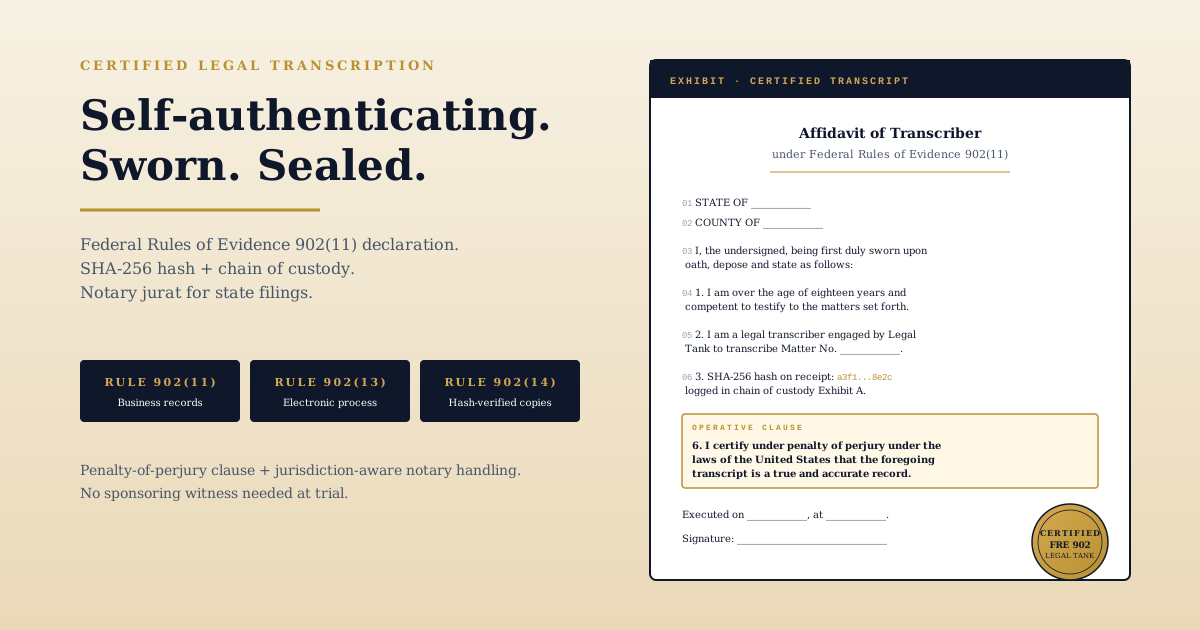
A certified legal transcript is the kind your filing can stand on without a sponsoring witness at trial. The certifier signs under penalty of perjury that the transcript is a true and accurate record of the source recording, which is what triggers Federal Rules of Evidence 902(11). For electronically captured depositions, 902(13) governs. For forensic copies tied back to a hash, 902(14) governs. The sample affidavit lower on the page is the language we sign on every certified delivery. The jurisdiction matrix tells you where a notary jurat is required on top of the declaration. The failure-mode section names the five reasons certified transcripts still get rejected at the courthouse, and how we close each one before the file leaves our hands.
902(11) · 902(13) · 902(14)
Three subparts. One certified delivery package per matter.
Rule 902(11)
Certified Domestic Records
Business records self-authenticate when the custodian or another qualified person signs a written declaration. The transcriber's affidavit attesting the transcript is a true and accurate record of the source recording is the document this subpart was written for.
Rule 902(13)
Electronic Process Output
Added 2017. Output of an electronic process or system, such as a forensic export from a recording platform, self-authenticates with a Rule 902(11)-style declaration. Lets a digitally captured deposition or interview stand without a sponsoring witness.
Rule 902(14)
Hash-Verified Copies
Added 2017. A copy of data from an electronic device, storage medium, or file self-authenticates when accompanied by a declaration that the copy was authenticated by a hash value. Used where the courtroom record needs to tie the transcript back to a forensic image.
Sample Certifier's Affidavit
The sworn language below is the language on every certified Legal Tank transcript. Fields fill in on delivery (matter number, file hash, recording duration, transcriber name). The structure does not change between matters because the structure is what triggers Rule 902(11).
EXHIBIT · CERTIFIED TRANSCRIPT
Affidavit of Transcriber under Federal Rules of Evidence 902(11)
NOTARY JURAT (state filings)
Subscribed and sworn before me this ____ day of ________, 20__.
Notary Public Signature ______________________________
EXHIBITS ATTACHED
- Exhibit A · Chain of Custody Log
- Exhibit B · SHA-256 Hash Verification
- Exhibit C · Marker Key & Speaker Label Key
What the affidavit is doing, in one sentence.
Federal Rules of Evidence 902(11) lets a business record self-authenticate when the custodian signs a written declaration under penalty of perjury. Paragraph 6 of the affidavit above is the operative clause. Without that sworn paragraph, the transcript needs a sponsoring witness at trial. With it, the transcript walks into the record on the document alone.
Where Notarization Is Required, Where It Is Not
The Federal Rules of Evidence 902(11) declaration framework is the federal-court default and is mirrored verbatim in most states. A handful of jurisdictions layer a notary jurat on top of the sworn declaration. The matrix below covers the venues that account for the bulk of certified transcription work at Legal Tank. Anything outside this matrix gets a per-matter rule check before delivery.
Jurisdiction
Federal court, all districts
Posture
Self-executingRule
Federal Rules of Evidence 902(11) / 902(13) / 902(14)
Requirement
Written declaration under penalty of perjury. No notary required. Reasonable written notice to adverse parties before trial, and the record and declaration made available for inspection.
Jurisdiction
California state court
Posture
Notary often requiredRule
Evidence Code § 1271; CCP § 2015.5
Requirement
Business-records foundation can be satisfied by affidavit. Code of Civil Procedure § 2015.5 permits a declaration under penalty of perjury in lieu of a notarized affidavit if executed in California, but counsel commonly attaches a jurat for out-of-state filings.
Jurisdiction
New York state court
Posture
Affidavit, notary requiredRule
CPLR 4518(a); CPLR 2106
Requirement
Business-records exception requires affidavit, not a bare declaration. Out-of-state attorneys may execute by affirmation under CPLR 2106 in limited circumstances. Notary acknowledgment on the certifier's signature is the safer default.
Jurisdiction
Texas state court
Posture
Self-executingRule
Texas Rules of Evidence 902(10); Rule 803(6)
Requirement
Texas 902(10) self-authenticating business records affidavit form accepted. Must be filed and served at least fourteen days before trial. Notary acknowledgment customary but the affidavit form is the load-bearing element.
Jurisdiction
Florida state court
Posture
Affidavit, notary requiredRule
Florida Statutes § 90.803(6)(c), § 90.902(11)
Requirement
Self-authenticating business-records exception. Written declaration sworn before a notary, with notice served at least ten days before trial. The notary jurat carries the certification.
Jurisdiction
Illinois state court
Posture
Affidavit, notary recommendedRule
Illinois Rules of Evidence 902(11)
Requirement
Mirrors the federal 902(11) declaration framework. Notarization is not strictly required but the trial bar commonly requests it because Illinois trial courts split on declaration acceptance.
Service of the Rule 902(11) notice on adverse parties is the certifying lawyer's responsibility on filing, not the transcriber's. The certified delivery includes a draft notice template and the recommended service window calibrated to the jurisdiction of filing.
The Five Ways a Certified Transcript Fails
A correctly drafted affidavit on its own does not make a transcript admissible. The certification has to hold up against an adverse-party challenge on five recurring failure points. Each is described below with the rule it offends and the way Legal Tank closes it on delivery.
Missing chain of custody log
The certifier swears the transcript is a true and accurate record of the source recording. The court still has to know that the file the transcriber received is the file counsel uploaded, with no intermediate transformation. Without a chain of custody log, the affidavit attests to the integrity of a record whose provenance is undocumented.
How we close itEvery certified transcript ships with a chain of custody log attached as Exhibit A to the affidavit. Source file name, SHA-256 hash on receipt, transcriber name, second-reviewer name, delivery hash, time stamps for each step. The log is not optional, it is what makes the affidavit do its work.
Unsworn certifier statement
A signed transcript is not a certified transcript. The Rule 902(11) shortcut requires a written declaration that recites the penalty-of-perjury language or, in jurisdictions that demand it, a notary jurat. A cover memo signed 'transcriber' without the oath is not a self-authenticating document and the court will require a sponsoring witness at trial.
How we close itThe affidavit on every certified Legal Tank transcript recites the federal penalty-of-perjury language verbatim. For jurisdictions that require notarization on top, the certifier executes before a notary public and the jurat is attached. The penalty-of-perjury language is what triggers Rule 902(11).
Inconsistent speaker labels across sessions
On multi-session matters, the deponent labeled THE WITNESS in volume one and DR. PATEL in volume two reads as two different witnesses on the certified record. Opposing counsel will use the inconsistency to argue the transcript is not a faithful record, which is exactly what the certifier swore to.
How we close itWe lock the speaker label key at the first session of a multi-volume matter and apply it consistently across every subsequent volume. The key is appended to the marker key in the affidavit exhibits, so the certified record is internally coherent across all sessions of the matter.
Hash digest mismatch on Rule 902(14) production
Rule 902(14) lets a forensic copy self-authenticate when the declaration attests the hash matches the original. If the hash logged on intake does not match the hash the certifier swears to, the entire 902(14) shortcut collapses and the production reverts to needing a sponsoring witness on the forensic capture.
How we close itHash is captured on file receipt and re-verified before the affidavit is signed. If the hashes do not match, the recording is returned to counsel as a chain-of-custody event before transcription proceeds. The certified delivery includes both hashes and the verification step, not just the final value.
Late or missing Rule 902(11) notice
Rule 902(11) self-authentication is conditioned on reasonable written notice to adverse parties of intent to offer the record, and on making the record and declaration available for inspection in advance. A perfect affidavit served the morning of trial does not make the transcript self-authenticating. The court will exclude the document, or require a sponsoring witness, on the notice failure alone.
How we close itEvery certified transcript ships with a draft 902(11) notice template and a recommended service window calibrated to the jurisdiction (fourteen days in Texas, ten days in Florida, reasonable notice in federal court, often interpreted as fourteen to thirty days depending on the district). Counsel still serves the notice, but the calendaring rule is on the page of the cover letter.
Certification Questions, Answered
Six questions counsel asks before sending a recording for certified work. Three pulled from People Also Ask for "certified legal transcription", three borrowed from the parent legal transcription pool where doctrine carries across.
What makes a transcript certified instead of just signed?
Does a certified transcript need to be notarized?
How long does it take to transcribe 1 hour of audio?
Will AI replace legal transcribers on certified work?
Can ChatGPT certify a legal transcript?
What is the difference between a certified transcript and an authenticated transcript?
Send the Recording. The Affidavit Comes with the Transcript.
Upload the source file, name the jurisdiction of filing, and the certified delivery package returns with the affidavit, the chain of custody log, the hash verification block, the marker key, and the draft Rule 902(11) notice ready for service.